Building Muscle at Home: Resistance, Progression and a Useful Training Log
Build a repeatable home muscle-training plan with bands, weights or bodyweight. Separate strength from muscle growth and use a practical log to guide progression.
Building muscle at home depends on repeatable resistance training, not owning a particular type of equipment. Bands, suitable weights and bodyweight exercises can each provide useful work. The practical question is whether the chosen movement challenges the intended muscles while leaving a clear way to adjust the demand.
A small program and a readable log make that decision easier. Keep the exercise recognizable across sessions, record what actually changed and resist the urge to replace the whole routine after one difficult workout.
Can resistance bands build muscle?
Yes, bands can be part of a muscle-building program. ACSM's 2026 guidance recognizes elastic and home-based resistance training as useful options. Equipment alone does not establish an effective program: your exercise selection, effort, repeated work and recovery still matter.
Are resistance bands effective? They can be, but distinguish strength from muscle size. A 2019 review by Lopes and colleagues found no clear advantage of elastic or conventional resistance in the strength outcomes it compared. It did not prove identical muscle growth for every band and weight routine.
Building muscle mass with resistance bands therefore calls for a suitable training process, not a promise borrowed from a strength study. More controlled repetitions can reflect strength or skill improvements. A temporary pump, soreness or a single better workout does not measure how much muscle you have gained.
What do resistance bands do in a home program?
Elastic supplies resistance that changes as it stretches. THERABAND's technical explanation describes this relationship for its own products. Band identity, stretch, routing and condition affect the task; one brand's color chart is not a universal load scale.
Organize the program around different jobs: a knee-bending movement, hip hinge, upper-body push and upper-body pull. Add smaller work for a clear purpose. A short thigh loop may challenge outward hip movement without making every squat a demanding whole-leg exercise. Bodyweight or weights can fill a slot that your available band cannot serve well.
Use the full-body home workout for movement choices, with the leg and glute and home back guides for their actual equipment arrangements. Choose versions you can control before adding more variations.
Choose useful effort without requiring failure
The later repetitions should require effort while remaining recognizable as the same exercise. Finish before grip, balance or a changing body position takes over. ACSM's public summary does not make momentary failure necessary for the average healthy adult; this is not a reason to make every set effortless.
For an adjustable first plan, choose a few familiar movements on two separated days. One or two working sets with a manageable repetition range can help establish a baseline. An 8–12 range is one recording example, not a universal muscle-building prescription. Rest until you can repeat the intended movement, and retain the amount of work you can recover from.
A training log needs more than band color or kilograms
Copy a setup and working-set log
| Setup to keep identifiable | My record |
|---|---|
| Exercise / taught version | ____ |
| Exact implement, band or weight / same physical item | ____ |
| Permitted attachment or body contact | ____ |
| Stance, grip and support | ____ |
| Starting / finishing points | ____ |
| Date / exercise | Work completed | Actual rest | Control / other demands | Next deliberate change |
|---|---|---|---|---|
| ____ | Set 1 ____; set 2 ____ | ____ | ____ | ____ |
| ____ | Set 1 ____; set 2 ____ | ____ | ____ | ____ |
For individual movement and setup lessons, use the full-body movement guide. This article explains the progression-and-recording process. A photograph with a partner holding a band does not authorise a self-anchored substitute.
Write the setup once: exact band or weight, permitted attachment or body contact, stance, grip and comfortable range. For bodyweight work, include support height and body position. Note equipment replacement as a new baseline. A personal setup photo can help; do not cut or puncture elastic to identify it. Inspect the actual arrangement each time.
| Session | Same exercise setup? | Completed work | Control and next decision |
|---|---|---|---|
| A | Band A; recorded stance, grip and range | Two sets: 10, 9 | Controlled throughout; repeat. |
| B | Unchanged | Two sets: 11, 10 | Same range and similar rest; continue. |
| C | Unchanged | Two sets: 12, 12 | Comfortably repeatable; consider one modest change. |
| D | Suitable stronger Band B; same permitted routing | Two sets: 8, 8 | Same movement retained; establish the new baseline. |
Record every working set, rest and a short effort note. An estimate of additional controlled repetitions is useful context, but it is subjective, especially while learning. Keep one line for unusual fatigue or other demanding activity so a single lower count does not automatically trigger a program change.
Progressive overload with resistance bands: change one thing
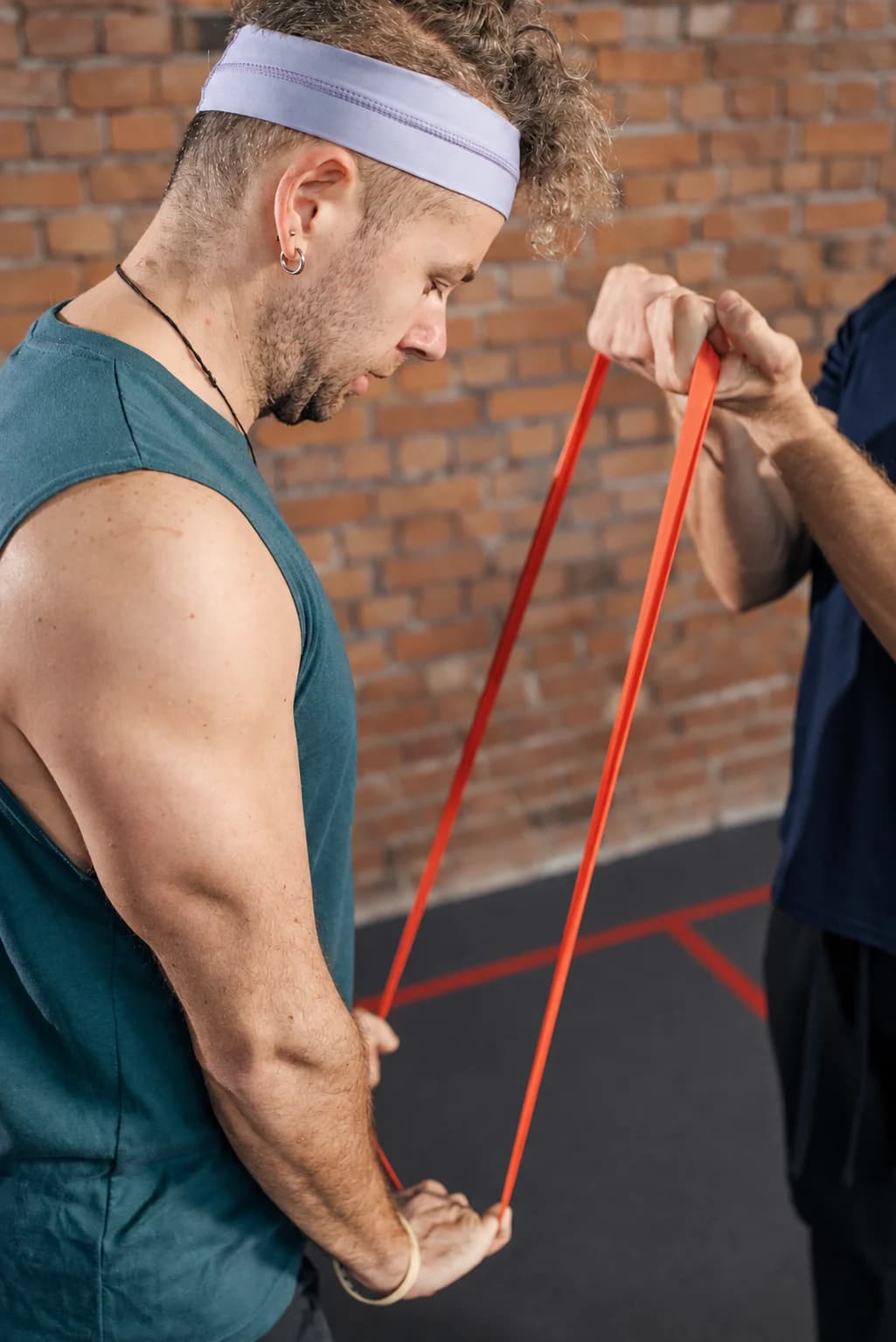
First keep the setup stable and add controlled repetitions within your chosen range. When the planned work is repeatedly manageable, consider a modest resistance increase or an additional set if recovery allows. These are different adjustments; do not change both while also shortening rest and altering the exercise.
If the next band is too large a jump, keep the current one while developing repeatable work, or choose an approved smaller adjustment. Shortening active band length or changing stance alters the task and must stay within the actual product's permitted stretch. Avoid improvised knots or stacked connectors to manufacture an intermediate level.
An advertised resistance range is product information, not a fixed mass lifted through the whole repetition. Do not multiply a maximum label by repetitions and call it kilograms of training volume. Track the repeatable exercise instead. A permitted setup change deserves a new note, not an unexplained personal record.
Check the limiting factor before buying stronger equipment
| What you notice | Useful next check |
|---|---|
| More repetitions with the same band | Was range shortened, starting tension reduced or momentum added? |
| Grip or balance ends the set first | Choose a suitable grip or more stable exercise rather than extra tension. |
| Only the last small portion is challenging | Consider another permitted band format, weight or exercise. |
| A replacement band feels different | Record a new baseline; equal colors do not establish equal resistance. |
| Several comparable sessions stall | Review workload, recovery and exercise fit before changing the entire plan. |
Weights can make some load changes easier to record, while bodyweight progression may involve leverage, support height or range. Those changes also need clear notes. A lighter number with better control can be useful practice; progression does not require a harder version at every session.
Choose equipment for the movement you want to progress
The PBGGAME five-long-loop set offers an elastic format: identify the individual loop and permitted setup in your log. The separate PBGGAME fixed dumbbell pair is source-listed at 1 kg per dumbbell. That light fixed load is useful only where it provides an appropriate challenge; another implement may be needed as the task becomes easy.
Confirm usable grip and exercise fit before choosing. The band-format guide distinguishes long loops from short hip loops and accessories. Neither a color nor owning a complete set determines the right load for every movement.
Keep a routine you can assess over time
Consistency includes manageable recovery, sleep and ordinary eating patterns. If the same task becomes unexpectedly difficult, repeat or reduce the work rather than force a scheduled increase. Stop for pain, insecure footing or damaged equipment.
Assess several comparable sessions, then keep what works and adjust a clear limitation. No band or article can promise a particular amount of new muscle by a deadline. A useful immediate result is knowing which work you completed, how well you controlled it and what you will repeat next time.