Strength Training for Runners: Fit Home Exercises Around Your Runs
Fit manageable home strength around your key runs. Compare bodyweight and long-loop exercises, scheduling options and recovery feedback without race-time promises.

Strength training for runners should fit the running week you actually have. Start by protecting the long run, intervals or other outing you value most, then add a modest strength session whose recovery cost you can observe. More exercises are not automatically a better addition.
At home, bodyweight and suitable bands can cover several useful movement jobs. The menu below combines a knee-bending task, hinge, sideways hip movement and calf work. It is general training, not a diagnosis of why running hurts or a promise of faster race times.
What the running research supports
The 2024 review by Llanos-Lagos and colleagues examined strength training and running economy. Its findings concern methods including high-load, plyometric and combined training. They do not establish that a light band circuit reproduces those programs or their results.
Read the Llanos-Lagos review at its original publisher for the tested methods and certainty limits. The NHS bodyweight demonstrations separately show the sit-to-stand, supported sideways leg lift and calf-raise formats used as references here. These sources do not turn the selected PBGGAME loop into tested running-economy equipment.
Use this home session to organize repeatable strength practice. If a performance goal calls for a more demanding program than your equipment can provide, seek suitable coaching rather than add endless light repetitions. ACSM's general 2026 guidance recognizes home-based and elastic training as useful formats, but does not validate this specific runner schedule.
Keep the home example separate from the research load
| Item to check | What belongs in your record |
|---|---|
| Original exercise teaching | The exact demonstrated setup and permitted band format: _____ |
| Research intervention | The original review’s training load, population and outcome: _____ |
| Your existing home task | The version already taught, actual band/weight and setup: _____ |
| Conclusion to avoid | A light-band example is not automatically the high-load intervention studied |
Resistance band exercises for runners: choose distinct jobs
Rehearse movements without meaningful resistance first. Choose versions with secure footing and a controlled return. A short thigh loop, long continuous loop and nonelastic strap have different jobs; owning one does not supply every band arrangement.
| Task | Documented home option | Keep the choice manageable |
|---|---|---|
| Bend the knees and hips | Bodyweight sit-to-stand or a comfortable mini-squat | Use a stable chair or appropriate support; rise and lower smoothly. |
| Hinge at the hips | Unloaded rehearsal, or a suitable long-loop Romanian deadlift | Use the actual permitted underfoot contact, grip and stretch. |
| Move the thigh sideways | Supported bodyweight sideways leg raise | Keep the trunk steady; this example does not add a band. |
| Train heel raising | Supported bodyweight calf raise | Lift and lower under control; keep reliable hand support. |
NHS strength exercises provide the bodyweight references. For the sit-to-stand, rise from a stable seat and control the return; keep any needed assistance. For a supported sideways raise, move the leg outward comfortably without leaning the trunk to create extra height. For calf raises, retain secure support and lower as carefully as you rise.
The long-loop deadlift guide includes a standing-start Romanian deadlift with the loop underfoot and exposed sections held directly. With a small knee bend and long arms, move the hips backward, then stand without a shrug or backward lean. You do not have to reach the floor. Confirm your own loop's grip, contact and stretch permissions; if it cannot fit, keep an unloaded hinge or choose another documented tool.
For more lower-body choices, use the leg and glute guide. The full-body overview adds pushing, pulling and trunk-control options when planning the rest of your training. Four lower-body movements do not automatically cover every major muscle group.
Put the session around your priority runs
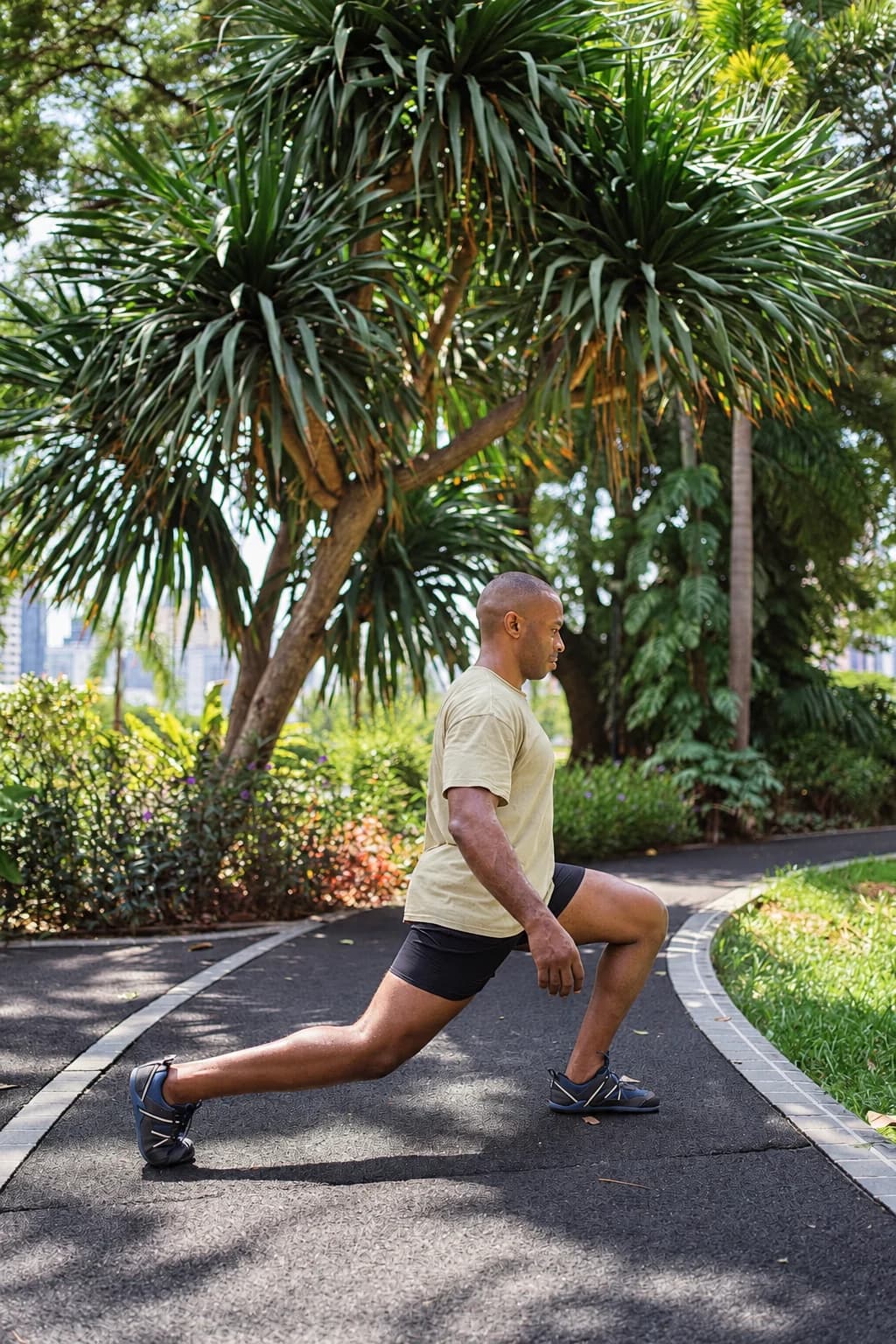
Mark the key runs first. Then choose a strength slot where you can learn its effect without gambling on tomorrow's important outing. There is no universal best order in this article: experience, current workload and your actual response matter.
| Your week | Editable scheduling choice | What to watch |
|---|---|---|
| An easy run leaves time and energy | Try brief strength afterward or later that day. | Keep the combined day manageable; stop if movement becomes untidy. |
| Tomorrow is a key run | Place new or demanding lower-body work elsewhere. | Judge the next suitable slot by recovery rather than a fixed rule. |
| Gym strength is already established | Count home band work within that workload. | Replace an appropriate accessory block instead of automatically adding another. |
| Travel or a busy week reduces capacity | Use fewer familiar movements or maintain the current amount. | Avoid compensating for missed training with an exhausting circuit. |
Start small enough to see the response
An optional first trial is one brief set of each chosen exercise, perhaps 6–10 controlled repetitions where that amount is manageable. Use fewer movements or repetitions if appropriate. Rest until footing, breathing and movement are ready again, and finish with some good repetitions still available. These are adjustable editorial examples, not the dose used in the running studies.
Repeat a manageable session before adding another set or a second weekly session. Check the next run: unusually heavy legs, higher effort on an easy outing or soreness that changes your normal movement suggest the new workload needs adjustment. Those observations guide planning; they do not diagnose an injury.
Progress one demand while keeping the week recognizable
- Record the exercise version, individual band, permitted setup, repetitions and a short control note.
- Keep the same range and setup when comparing sessions. Add a repetition before changing several demands together.
- When work becomes repeatedly manageable, consider one modest resistance or volume change, then observe recovery.
- Avoid sharply increasing running workload and strength work at the same time. A demanding race week can be a reason to maintain or reduce strength.
- Stop the provoking activity for pain, altered walking or symptoms that persist into running, and get individual guidance.
A stronger loop is useful only if the task remains suitable. Color and printed resistance ranges do not measure the force in your exact movement. The home progression guide explains repeatable logging and misleading improvements such as shorter range or changed grip.
Keep home and travel equipment familiar
The PBGGAME four-long-loop option is a format to compare for an appropriate elastic task. Identify the individual loop in your notes and confirm its instructions rather than assume every band fits the hinge. A harder band is not a remedy for insecure footing.
Rehearse the actual setup before travel, inspect elastic for wear and use only approved contact or attachment methods. An unfamiliar door, chair leg or railing is not a ready-made anchor. The portable kit guide helps organize a familiar selection. If space or recovery is limited, shorten the session; consistency does not require reproducing your whole gym workout.