Seated and Supported Home Exercises: Build a Stable Routine
Choose seated and supported home exercises around a stable chair, manageable movement and suitable band formats. Includes older-adult considerations and a printable record.
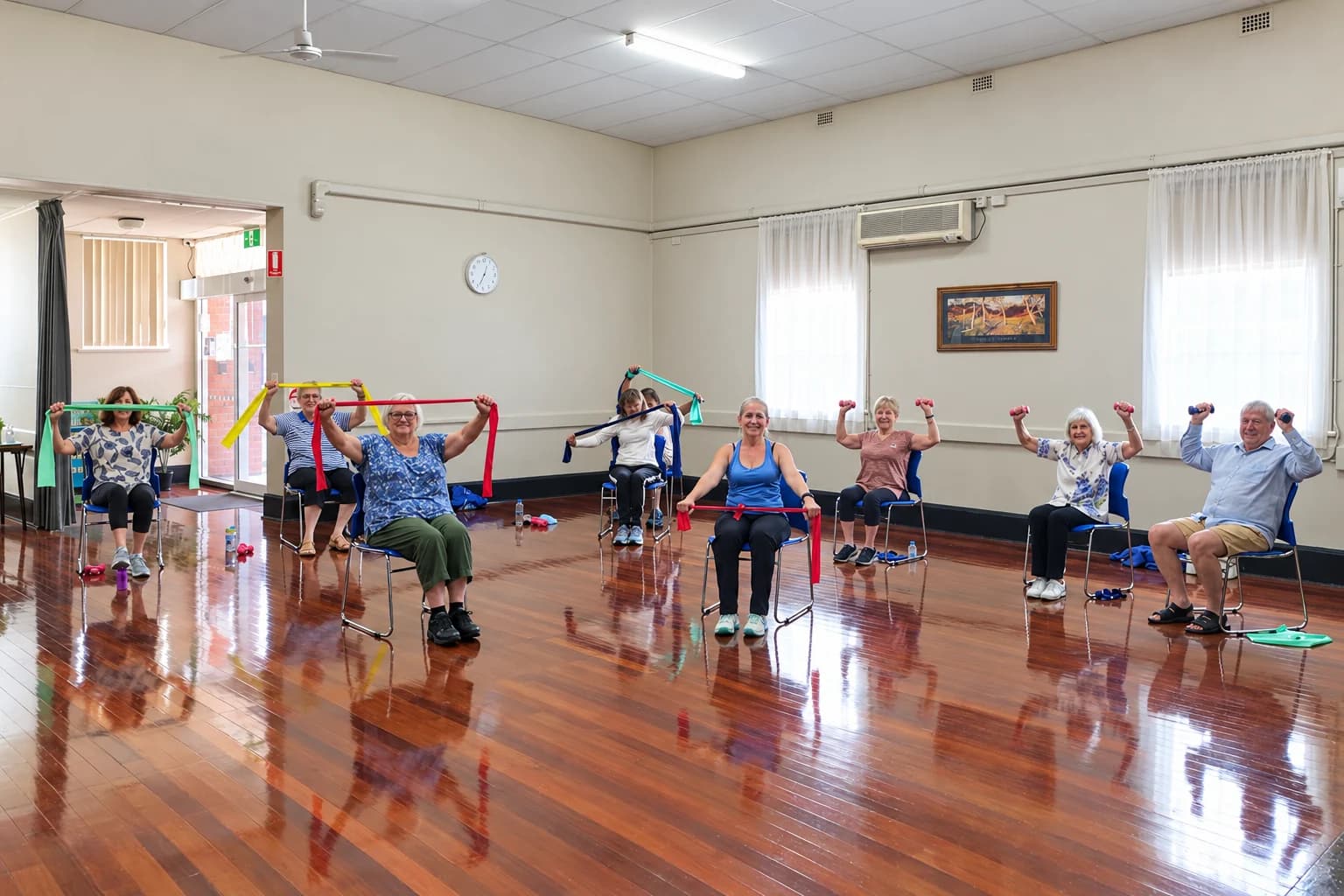
A useful seated routine starts with a chair that stays still, supported feet and movements you can enter and leave comfortably. Bands are optional: knee extensions, heel raises and gentle marches can be practiced without elastic. Choose the position before adding equipment.
Start with the option that fits your equipment
| Entry | What you need | Where to begin |
|---|---|---|
| Seated without a band | A suitable stable chair and clear floor | Chair checks, then the unresisted seated movements below |
| Add a permitted flat band | The documented band format and contact arrangement | Read the band-specific instructions before adding it |
| Separate supported standing option | The stated support and a suitable standing task | Use that task’s own setup and exit; it is not a required progression |
This guide combines seated resistance band exercises, simpler options and a printable record. It is for general exercise, including older adults who can use the positions comfortably. Age alone does not select a band or workload; individual conditions or uncertain transfers may require another plan.
Check the chair and the way in and out
NHS sitting-exercise guidance recommends a solid, stable chair without wheels, with the feet flat and knees comfortably bent. Choose a seat and clear floor area that let you move without sliding, tipping or catching a foot. Avoid a soft low sofa or a chair whose height leaves the feet dangling.
- Place the chair on a level surface and check it remains steady when you shift gently.
- Keep the route for sitting down and getting up clear; arrange equipment within easy reach.
- Keep a suitable fixed support nearby if you normally need it for standing. A support for balance is not automatically a band attachment.
- Inspect elastic, grips and connectors before use. Follow the actual model's permitted contacts and stretch limits; do not fasten it to chair legs, handles or other movable furniture.
For chair resistance band exercises, you still need secure contact and a controlled way to unload. If getting elastic over the feet or around the legs is awkward, leave it out rather than make setup the hardest task.
Build a short seated session from different movements
Begin with comfortable unresisted movement and normal breathing. Select a few manageable tasks from this menu. There is no compulsory circuit or repetition count. Rest until you can repeat the same organized position.
| Task | Simple starting choice | Keep in mind |
|---|---|---|
| Lift the thigh | Alternate small seated marches | Keep the trunk quiet and lower each foot with control. |
| Move the knee | Straighten one knee comfortably without a band | Keep the thigh supported; lower smoothly instead of kicking. |
| Move the ankle | Seated heel and toe raises | Keep the remaining foot contact secure; avoid rocking the whole body. |
| Open the thighs | Unresisted movement, or the documented compatible flat-band arrangement | Both feet stay planted; more width is not the goal. |
| Bend the elbow | Unresisted curl, or a permitted underfoot flat-band curl | Use a grip and return you can control without lifting a foot. |
A few slow repetitions may be enough for an initial setup check. Finish before posture, grip or foot contact changes, then repeat a comfortable amount next time. Choose your starting work by current ability and other activity, not an age-based target.
Resistance band exercises for legs while sitting: match the arrangement
The Finding Balance Alberta booklet, pages 8–9, demonstrates hip opening with a flat band tied above the knees. Keep both feet planted, open the knees a comfortable distance and guide them back without leaning or rolling onto the outer feet. Only use a knot or tied arrangement if your own band instructions permit it.
A ready-made mini loop needs separately suitable fit and resistance. Start unresisted if positioning it is uncertain. This example places the band above the knees, not across the joints or around the ankles to make it harder.
For leg exercises with resistance bands for seniors, the exact loading direction matters more than the label. The booklet's resisted knee extension uses a band around both ankles with one foot planted. Our menu instead offers an unbanded knee extension as a simpler separate choice. Do not assume the hip-opening loop arrangement provides the same knee-extension task.
Pages 12–13 show seated toe and heel raises, with an optional thigh band. That inward thigh tension is not calf resistance. Plain heel and toe raises simplify the task. The leg and glute guide explains other loading formats.
A seated curl is not every upper-body exercise
For the booklet's actual seated band curl, pages 20–21, the flat band passes beneath the feet, the elbows stay beside the body and one forearm bends at a time with the thumb pointing upward. Return slowly. Confirm that your band permits this grip and underfoot contact; keep the shoes planted and stop if it slips.
Avoid winding elastic tightly around a wrist or finger to compensate for an uncertain grip. Use unresisted elbow bends or omit the task. The booklet's later pull-apart has bent elbows near the ribs and outward forearm rotation; it is not a straight-arm chest-height pull-apart.
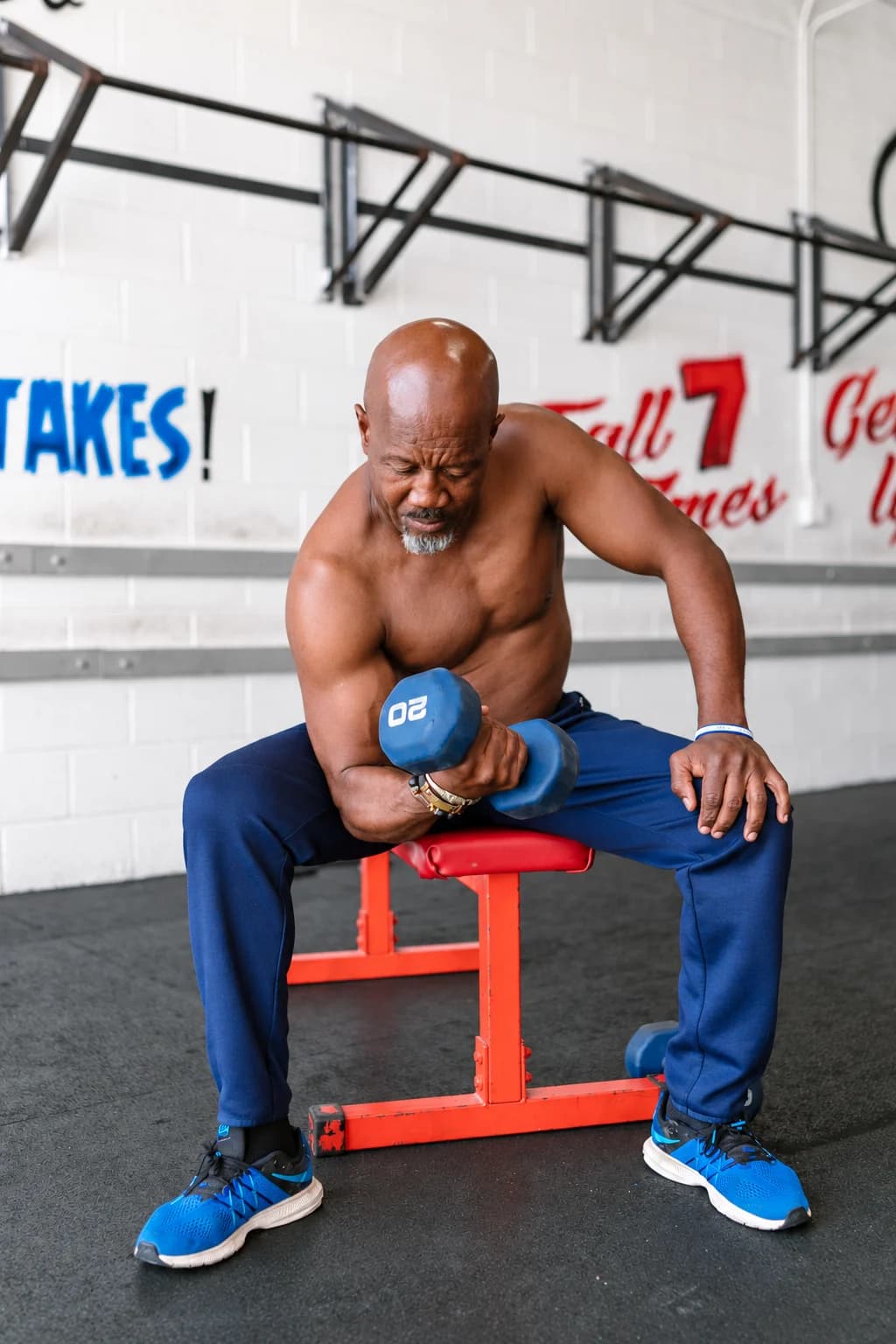
A curl differs from a row or press. Use the home arm guide or full-body overview for broader choices whose equipment and positions suit you.
When supported standing is a suitable option
NHS strength exercises include a controlled sit-to-stand, supported standing heel raise and wall press-up. Choose these only if the transitions and footing suit you. Rise and lower slowly from a stable seat, keeping any assistance you need; for standing heel raises, retain reliable hand support. At a suitable solid wall, bend and straighten the arms under control.
These have different weight-bearing demands from seated knee or ankle movement. Do not remove support simply to progress. NHS's exercise titled Leg extension moves a straight leg backward while standing; it is a hip movement, not the seated knee extension in our menu.
Resistance bands for seniors: select by ability, not an age label
Resistance band exercises for older adults may be seated, supported standing or a combination. Check that you can enter the position, maintain it while moving and unload the equipment. Keeping support while improving strength is a valid choice.
CDC guidance for older adults includes aerobic, muscle-strengthening and balance activities, with strengthening on at least two days each week. A seated leg-and-arm menu can contribute some work, but does not replace that whole mix or provide standing balance practice. Choose activity within your abilities when the full recommendations are not currently manageable.
Repeat a comfortable session, then change one variable such as repetitions or suitable resistance. Record control and how ordinary activity afterward felt. Stop for pain, dizziness or unexpected loss of control; use individual guidance when a condition affects your activity.
After an interruption, CDC recommends restarting at a lower level and building back gradually. The old workload is useful history, not a requirement for your first session back.
Resistance band exercises for seniors PDF and session record
Download our resistance band exercises for seniors PDF for chair checks, seated and supported choices, band-format notes and a blank practice record. This original cue sheet accompanies the article; it neither reproduces the source booklet nor provides an individual rehabilitation plan.
Optional extras for hand work or carrying equipment
For separate hand work, the PBGGAME pair of manual five-plunger hand trainers is a different tool from elastic or band handles. The exact pair is $24.99 and packed 349 g. It does not solve insecure band grip or establish a treatment for painful hands.
If you also carry a rolled mat to a suitable class, the PBGGAME open mat sling is transport-only. The cyan - 1 bag option is $24.99 and packed 318 g; no mat is included. Its shoulder loop is not a band anchor, balance support or transfer aid.
Neither purchase is required. These are catalog examples without a physical test for this routine; packed mass is a shipping record, not exercise resistance or supported load.