Home Cardio for Weight Management: Calories, Activity and Habits
Build repeatable home activity with rope, walking, cycling and strength work. Understand calorie estimates, active time and the limits of belly-fat promises.

Home cardio can support weight management when it becomes a manageable part of your week. Jump rope is one option; walking, indoor marching, dancing or suitable cycling may fit other days better. Choose movement you can perform comfortably and organize repeatedly, then judge the habit by what you actually complete.
A calorie estimate can help describe a session, but it cannot promise a weight result or tell your body where to lose fat. This guide explains the role of activity, a practical way to plan it and the assumptions behind rope calorie calculations. You do not need to turn every workout into a calorie target.
Recalculate a jumping-portions estimate
Use kilograms, actual jumping minutes and one matching activity description. Gross kcal = MET × kg × active minutes ÷ 60. Additional kcal above the standard one-MET baseline = (MET − 1) × kg × active minutes ÷ 60. These are two outputs for the same minutes; do not add them together.
| Input or output | Example: continuous active time | Example: ten 20-second work periods | Your record |
|---|---|---|---|
| Mass | 70 kg | 70 kg | ____ kg |
| Published category assumption | 8.3 MET; slow two-foot rhythm bounce, fewer than 100 skips/min | Same 8.3-MET assumption | Description / code / MET: ____ |
| Actual jumping time | 10 minutes | 200 seconds ÷ 60 = 3.33 minutes, before any interruptions | ____ seconds ÷ 60 = ____ minutes |
| Gross estimate | 8.3 × 70 × 10 ÷ 60 ≈ 97 kcal | 8.3 × 70 × (200 ÷ 60) ÷ 60 ≈ 32 kcal | ____ kcal |
| Above-baseline estimate | 7.3 × 70 × 10 ÷ 60 ≈ 85 kcal | 7.3 × 70 × (200 ÷ 60) ÷ 60 ≈ 28 kcal | ____ kcal |
| What the result excludes | Individual metabolic measurement | Rest, resets, preparation and finishing | Unmeasured time / assumptions: ____ |
Choose gross or additional according to the question you are recording. If only the session clock is known, leave jumping time unknown instead of assigning the rope category to every minute.
Does jump rope help you lose weight?
Jumping rope uses energy and can contribute to an activity routine. The CDC guidance on activity, weight and health describes physical activity alongside food and drink intake, while emphasizing that individual activity needs vary. It does not establish that a particular rope routine will produce the same result for everyone.
Weight management also involves circumstances beyond the workout. The CDC planning framework includes eating patterns, activity, sleep and stress management, and recognizes influences such as health conditions, medicines and environment. This article cannot set an individual eating plan, energy intake or target weight.
Does jumping rope burn fat? Exercise uses energy, but the fuel used during one session and a longer-term change in body fat are different questions. Neither a sweaty finish nor a high calculator result demonstrates how much body fat changed. A routine can improve your exercise skills and consistency without delivering an advertised transformation.
Choose goals you can observe directly: finding a workable activity slot, completing a manageable session, learning rope timing or taking regular walks. If you want personalized weight-management support, seek someone appropriately qualified to consider your health and circumstances. Exercise should support your day, rather than become punishment for eating.
Start with the activity that fits the day
Walking needs a suitable place to walk and can fit a trip, a break or a planned outing. Indoor marching or dancing may offer another option when the available room and movements are suitable. Rope needs clearance for the entire cord path and enough coordination to connect turns. A stationary bike requires access and adjustment; outdoor cycling also involves handling, route and traffic decisions.
Use those requirements to choose a session instead of ranking activities by a generic calorie rate. An activity that fits your home, access and preferences is easier to organize than one that repeatedly runs into the same obstacle. You can choose different options for different days without treating the easier-looking one as a lesser achievement.
Keep muscle-strengthening work in the wider plan too. The CDC adult framework includes aerobic activity plus at least two days of strengthening that involves the major muscle groups. Its broad health targets are not a beginner rope quota or a guarantee of weight loss. Build toward an appropriate routine from your current ability and include activity you already do.

Build a jump rope routine for weight management
If you are learning the movement, begin with the beginner rope workout. For someone already comfortable with brief rope intervals, two nonconsecutive practice slots can be an adjustable scheduling example. They are not an optimal frequency proven to cause weight loss, and rope does not need to supply all your aerobic activity.
- Choose two realistic windows and identify where you will practise. Include setup, a gradual start and an easier finish.
- Use familiar short work periods with enough recovery to repeat the movement under control. End before repeated catches become a rushed struggle.
- Put an alternative beside each slot, such as a manageable walk when the rope space is unavailable.
- Leave room for suitable strength work, existing sport, ordinary responsibilities and rest.
For scale, six rounds of 20 seconds jumping and 40 seconds walking or resting contain two planned jumping minutes inside a six-minute main block. Preparation and finishing add time. This example may need shortening; it is not a complete weekly program. Use it to understand work and recovery, rather than a minimum you owe the timer.
The American Heart Association preparation guidance supports easing into activity and reducing effort at the finish. For a longer planning framework, the 30-day rope plan can help organize practice and review days. A calendar gives the habit structure; it does not create a weight-loss deadline.
How many calories does jumping rope burn?
An estimate needs body mass, actual jumping time and an assumed intensity. The Compendium definition of terms uses one standard MET as approximately one kilocalorie per kilogram per hour. This supplies a simplified calculation convention, not a measurement of your metabolism. In everyday fitness language calorie usually means kilocalorie; kcal makes the unit explicit.
The 2024 Adult Compendium sports table lists these rope activities. Match the description to the work you actually performed. Do not choose the largest value because you reached that pace briefly or want a larger total.
| Published rope activity | Activity code | MET value |
|---|---|---|
| Slow two-foot rhythm bounce, fewer than 100 skips per minute | 15552 | 8.3 |
| General two-foot plain bounce, 100 to 120 skips per minute | 15551 | 11.8 |
| Fast rope jumping, 120 to 160 skips per minute | 15550 | 12.3 |
A pace label is separate from personal effort. The CDC intensity guidance distinguishes an activity category from how hard it feels to the person doing it. Moderate effort generally allows talking but makes singing difficult; vigorous effort usually allows only a few words before a breath. Do not accelerate merely to fit a calculator category.
Using the simplified convention here: gross kcal = MET x body mass in kilograms x active minutes / 60. Divide pounds by approximately 2.205 if you need kilograms. For a hypothetical 70 kg adult, about 154 lb, ten active minutes at an assumed 8.3 METs gives 8.3 x 70 x 10 / 60 = about 97 gross kcal. The example mass is an input, not a target body weight.
Changing the assumption changes the result. With the same mass and active time, 11.8 METs gives about 138 gross kcal and 12.3 gives about 144. Those are recalculated examples, not three measured sessions or evidence that chasing a faster category produces a better weight-management plan. Rounded totals are more honest than long decimals.
Count jumping separately from the session clock
Ten rounds of 20 seconds jumping and 40 seconds resting form a ten-minute main block. Planned jumping is 200 seconds, or about 3.33 minutes; planned rest is about 6.67 minutes. If you trip and reset during the work periods, actual jumping is lower again. Applying the rope category to the entire ten minutes would mislabel the activity.
For the same 70 kg and assumed 8.3 METs, those planned jumping portions give about 32 gross kcal. This excludes the energy used during rest, preparation and finishing. It is therefore a jumping-portions estimate, not a total-session estimate. Walking recovery and standing recovery also differ; neither should silently inherit the rope value.
Record actual time when you can and note interruptions when you cannot measure them precisely. Do not add harder rounds to make the planned calculation come true. The record is there to describe completed exercise and help adjust the next session.
Gross and additional calories use different baselines
Gross includes the standardized resting energy attributed to those same active minutes. To estimate energy above that one-MET baseline with this convention, use: additional kcal = (MET - 1) x kilograms x active minutes / 60. For the ten-active-minute, 70 kg, 8.3-MET example, this gives about 85 kcal above the standard baseline, compared with about 97 gross.
The roughly 12-kcal difference belongs to the assumed baseline. It is not a direct measurement of your resting metabolism. A device may define active calories differently. When two estimates disagree, compare the time window, entered inputs, calculation convention and gross or above-baseline definition before treating the difference as an accuracy test. Avoid subtracting resting energy twice.
The Compendium's corrected-MET explanation says its values standardize population research rather than determine an individual's precise energy cost. Personal characteristics and the exact movement introduce uncertainty. Keep the assumptions with the result, and avoid converting an estimated exercise total directly into a predicted body-fat change.
Can jumping rope burn belly fat?
A rope routine cannot reliably choose belly fat as its target. Feeling your abdominal muscles work does not identify which fat depot supplies energy. Changing footwork, adding abdominal exercises or choosing a heavier rope does not establish targeted loss around the waist.
A 2022 systematic review and meta-analysis found no pooled localized-fat benefit in its comparisons of trained and untrained limbs. A separate small abdominal-exercise trial reported improved abdominal endurance without significant changes in its measured fat outcomes. Neither was a jump-rope trial. They support rejecting reliable spot-reduction promises, while keeping exercise performance and local fat change separate.
A before-and-after photo cannot show what one rope routine caused without reliable information about timing, conditions and other changes. Nor does a particular body shape show how much someone exercises or how well they manage a habit. You do not need a transformation picture to recognize improved confidence, steadier practice or an activity you enjoy.
Review the habit before adding more work
After a week or two, ask what helped the sessions happen. Record the chosen activity, actual active time, rests, approximate effort and whether the session fit the day. Note a practical obstacle such as an unavailable room or an overfilled schedule. Changing the plan to address that obstacle can be more useful than increasing the exercise.
If the current amount is manageable, repeating it is a valid choice. If movement becomes uncontrolled or fatigue makes ordinary activities difficult, reduce the work. When a change is useful, adjust one feature: a little active time, one round or a different scheduling cue. Include walking, cycling, sport and strength work when judging the whole week.
Body weight, if you choose to track it, is one piece of information rather than a workout score. Avoid using a single reading to prescribe punishment intervals. A missed session does not need an extra-hard replacement. Stop for pain that changes your movement or increases; symptoms, injury or health restrictions require advice specific to your situation.
Equipment should solve a practice problem
Choosing a weighted jump rope for weight loss does not provide a verified calorie multiplier or a guaranteed fat-loss advantage. Buy for a defined movement and equipment need. The rope you can control, the area available and the activity you want to repeat matter more than a body-transformation claim.
Add a defined surface to your established rope area with the PBGGAME oval mat in Navy. Compare its usable footprint with your cord contact and check compatibility with your floor. Keep the full rope path clear beyond the mat and follow the model's surface instructions.
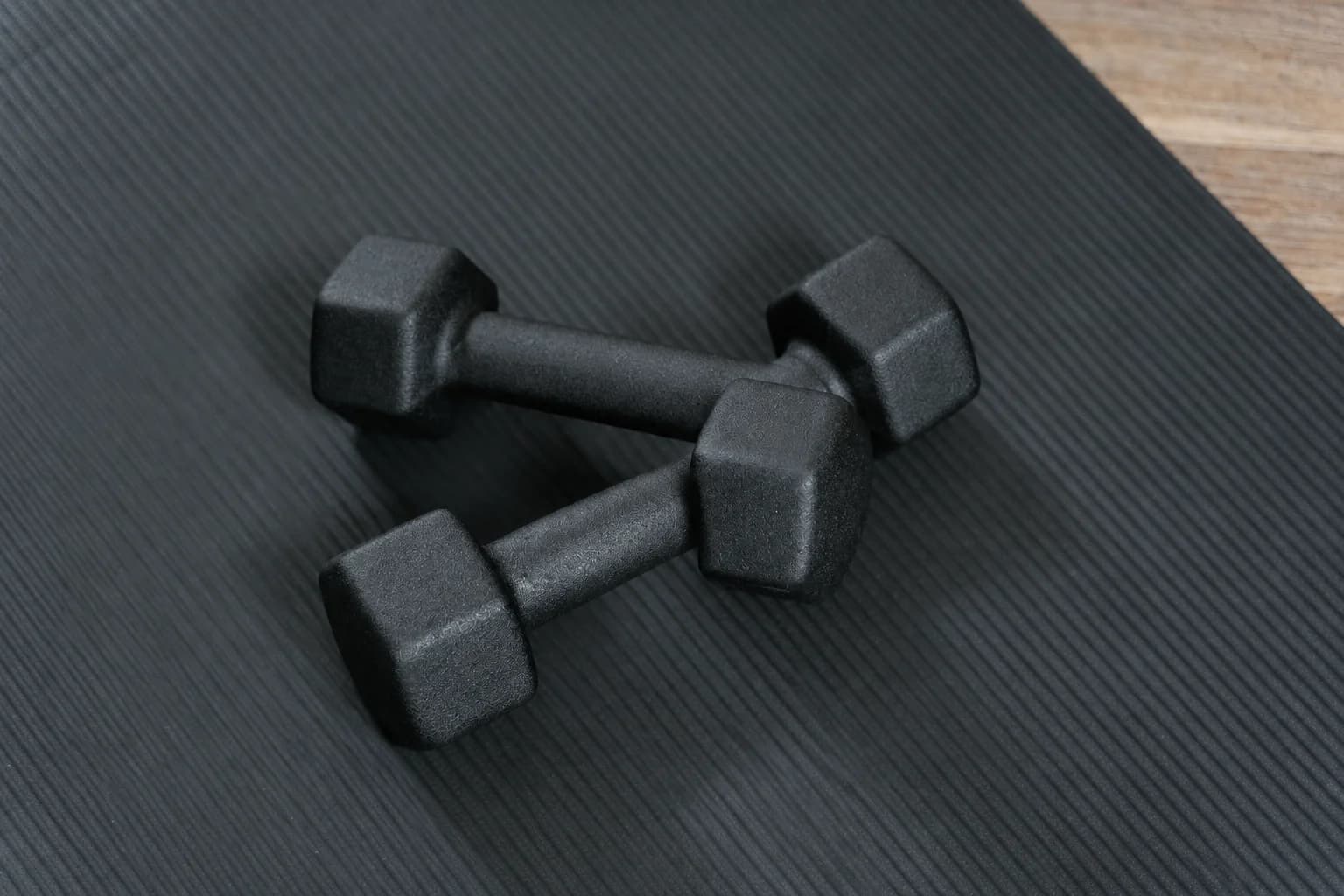
For separate strength practice, the light-green 1 kg dumbbell pair illustrates a different equipment format. Put the rope down before changing activities. A fixed light pair will not suit every exercise or person; the home strength guide explains how different movements fit a wider routine.