Choosing a Yoga Bolster: Shape, Fill and the Positions You Use
Compare bolster shape, filling and dimensions against positions you know, then check handling, storage and separate cover-and-core care before buying.
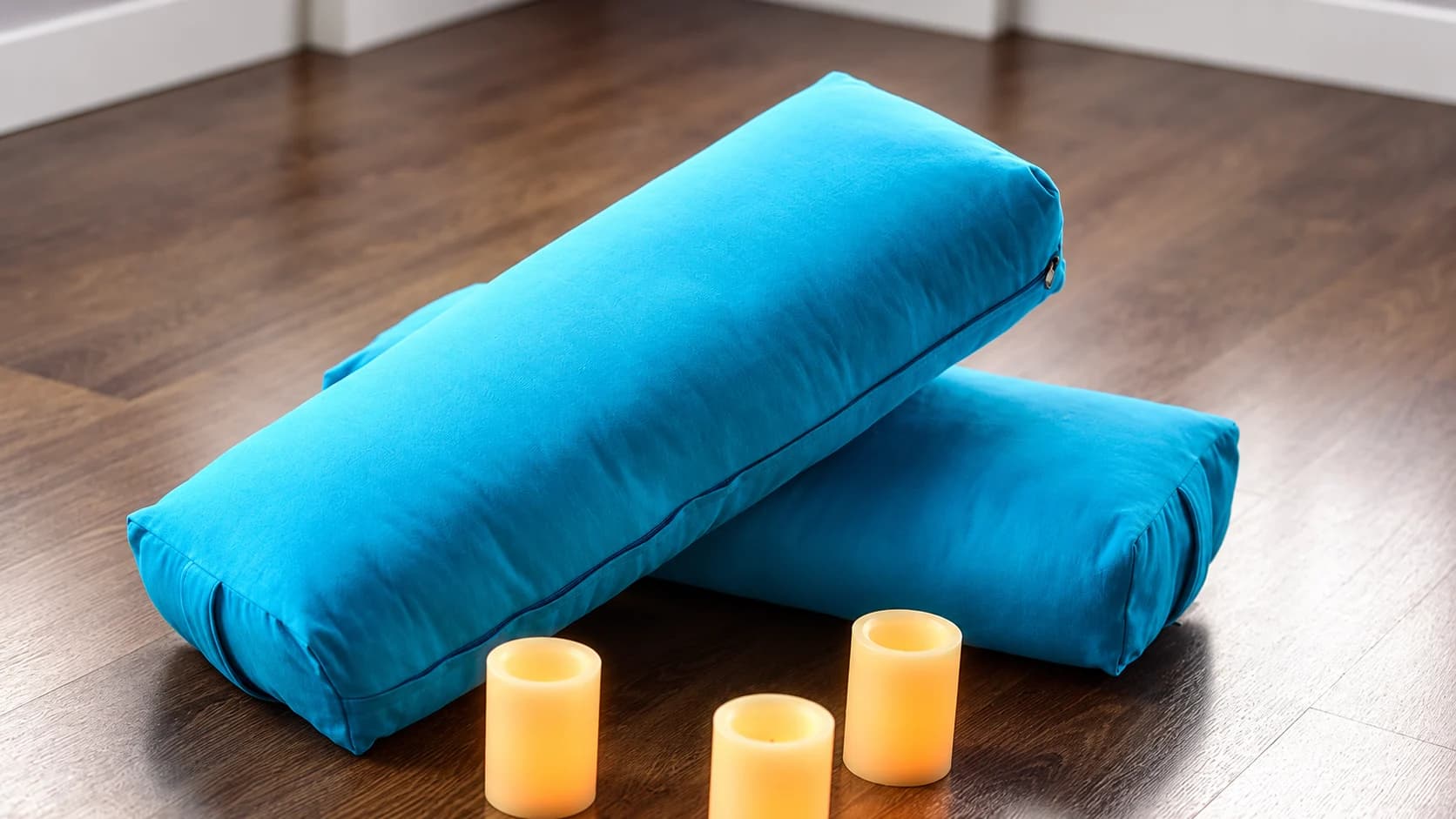
Choose a yoga bolster for the support arrangement you already use. Begin with its job in that position, then compare shape, dimensions, filling and care instructions. A familiar studio prop can give you a useful reference: note what it supports, how it is placed and which part of its size matters to that setup.
This guide compares buying details rather than teaching new bolster poses. Keep the selection connected to positions you have learned, and check an unfamiliar arrangement with your teacher before choosing equipment for it.
How to choose a yoga bolster: start with its job
Write down one or two positions in which you expect to use the bolster. Describe the contact in ordinary terms: along the torso, behind the knees or beside the body in an already-taught side-lying arrangement, for example. Add whether the prop lies lengthways or across the mat and which height your teacher used.
If you can, measure the familiar prop or ask for its listed dimensions. A note such as “rectangular, broad face on the mat, supporting this part of the body” is more useful than choosing by the word “large.” Include the route into and out of the position, so you can check that the proposed prop belongs in the whole arrangement.
Use that note as a short buying brief. It should tell you the shape to compare, the contact area you need to check and any handling requirement, such as carrying the bolster between a cupboard and the mat. You can then read a product page with a specific task in mind.
Round vs rectangular yoga bolster: compare the contact
Hugger Mugger's official bolster discussion distinguishes a rectangular bolster's broad, flat base from a round bolster's cylindrical shape and curved contact. Use those profiles to compare the arrangement you know:
| Shape | Profile to inspect | What to compare with your taught setup |
|---|---|---|
| Rectangular | Broad flat faces, with separate length, width and height. | Which face rests on the mat, how wide the contact is and the resulting height. |
| Round | A cylinder, usually described by length and diameter. | Where the curved surface makes contact and how the diameter relates to the support you learned. |
The shape name does not supply the measurements. Yogamatters describes its own rectangular bolster as lower and wider than its own round model. That comparison concerns those products; check the figures for any two bolsters you are considering.
Also check the product's intended role. A round meditation seat and a cylindrical body bolster can have different proportions and uses. Compare the actual bolster dimensions and description, rather than treating every round cushion as the same piece of equipment.
Yoga bolster firmness: check support under pressure
Hugger Mugger connects firmness to how the bolster retains the height needed in the position. That gives you a practical question: when used in the familiar arrangement, does it maintain the support you expect? Choosing the hardest-sounding option does not answer that by itself.
Read the construction details alongside any words such as “soft” or “firm.” Yogamatters' cited rectangular model uses recycled polyester fibre filling and allows some filling to be removed to change its density. That adjustment belongs to that model's instructions. Check whether another product actually offers an adjustable filling before assuming its feel can be changed in the same way.
If you can try a bolster in a taught position, notice its contact and remaining height, then compare those observations with the prop you know. If you are buying online, look for the filling description and any stated firmness information. Ask about an unclear detail before ordering. A photograph can show the outline and cover; the compression you are trying to compare needs a clearer description or an opportunity to try it.
Measure the prop, then plan where it will live
Record length, width and height for a rectangular model, or length and diameter for a round one. Check the units before comparing listings. Keep those dimensions beside your note about the intended contact, so you can see whether a difference is in length, width or height rather than treating every size change as equivalent.
Use a tape measure to mark the footprint on the floor. Check where the prop would sit on the mat and whether the surrounding space remains clear for the entry and exit you learned. This shows the space it occupies; use the familiar setup and the product's support information to assess the contact itself.
Next measure the storage space with the prop's full dimensions in mind. Check the shelf opening as well as its internal space, and decide where the bolster will go after practice. Include the mat and other equipment when checking that route, so the stored prop does not block the next setup.
For handling, check whether the product has a carry handle and whether its actual item weight is listed. If you need to carry it regularly, those are useful details to confirm. Use the manufacturer's storage instructions if it needs compression or a particular orientation; avoid planning to force it into a space smaller than its listed size.
Read the cover and core care separately
A removable cover makes two care questions worth checking: how to clean the cover and how to care for the filling or core. Find the instructions for each part before deciding where you will use and store the bolster.
Look for the permitted washing method, temperature and drying instructions on the supplied label. Keep those instructions with the item. A washable-cover statement alone does not establish a washing method for the inner support. If a listing omits a setting you need, ask the seller or maker rather than copying the instructions from a different bolster.
Check access to the cover as well. If it uses a zip, look at how the cover comes off and whether the maker explains how to put it back on. You will want a cleaning arrangement you can follow without having to guess how the filling should be handled.
| Rectangular foam option: dimension map | Model detail | Fit and care check |
|---|---|---|
| Long side, L | 65.0 cm | Outer length; assess contact length in your intended position |
| Short side, W | 24.9 cm | Outer width |
| Height, H | 15.2 cm | Uncompressed height; check retained height for your intended position |
| Cover | Removable and described as washable | Exact wash temperature/drying settings need its label |
| Foam core | Three-layer foam | Follow this foam core's care instructions; confirm that filling adjustment or whole-core washing is permitted before proceeding |
Before ordering, ask for this model’s care-label photo and separate cover/core instructions through PBGGAME contact. If a taught position depends on retained height under load, request evidence for that use rather than treating 15.2 cm as the height it will retain.
Consider the actual rectangular option
The Blue triple-layer foam yoga bolster is a rectangular body bolster with listed dimensions of 65.0 by 24.9 by 15.2 centimetres. It has a three-layer foam construction, an end carry handle and a removable washable cover. Compare those dimensions with the arrangement you learned before choosing it.
Use the supplied care label for the cover's washing and drying details. Keep care of the foam core as a separate question; the removable cover does not establish that the whole bolster can be machine-washed. If compression or remaining height is important to your setup, ask for that information rather than inferring it from the listed dimensions.
For the difference between class purposes in which bolsters may appear, see the restorative yoga vs yin yoga guide. Use the instructions for your particular position when deciding what support to buy.
Check the buying brief before ordering
- The shape and dimensions correspond to the support arrangement you know.
- You understand what the filling description says and whether adjustment is actually permitted.
- The full prop fits the practice space, storage opening and route between them.
- Handling details meet your needs, including a handle or item-weight information where relevant.
- Cover and core care are clear, and you have checked any important missing detail with the seller.
Keep the measurements and setup note with the product information. They give you a specific basis for comparing another option or asking your teacher about a difference before you buy.