Balance Boards vs Stable-Floor Practice: When Instability Adds a Task
Decide whether to practise balance on stable ground, retain consistent support for strength work or learn a moving board. Compare tasks before buying equipment.
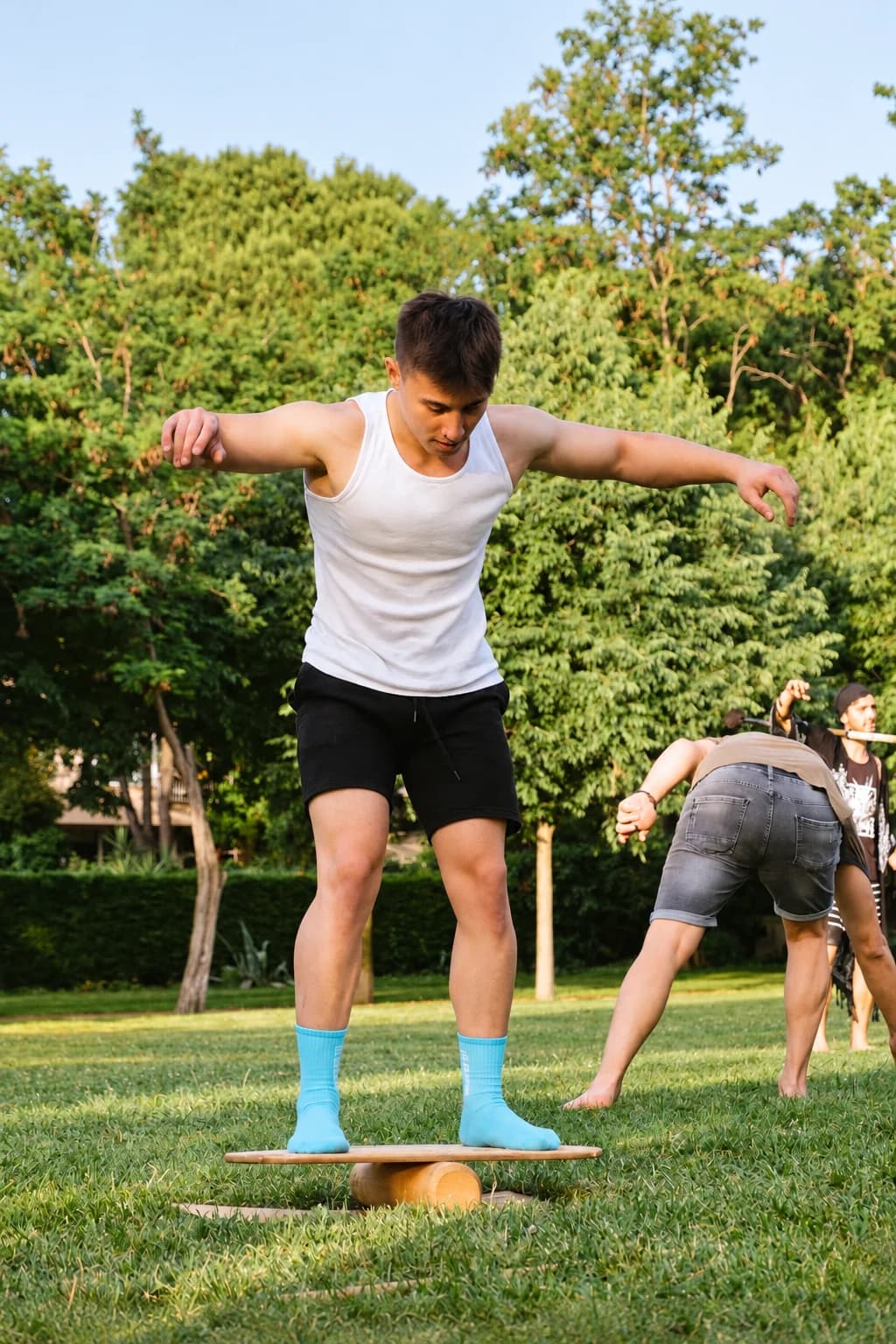
An unstable board adds a moving support to the task you are performing. That can be a useful skill to practise, but first decide what you want to control: your position on ordinary ground, a familiar strength movement, or the board itself. Each choice gives the session a different purpose.
You can practise balance on stable ground without buying equipment. A board becomes an option when managing its particular movement is relevant to your goal and you have an appropriate setup, support and way to finish.
Balance boards versus floor balance exercises: choose the task
| Task choice | What stays still or moves | What to observe | What this does not show |
|---|---|---|---|
| Familiar supported floor-balance task | Floor remains fixed; the taught body position changes | The chosen contacts, support and controlled return | That buying a board is the next required step |
| Specific moving-board skill | The exact base moves in its permitted way | Model identity, retained support and known entry/exit | Transfer to every balance or strength task |
| The 2002 study below | Stable furniture compared with Swiss-ball support | Acute force in specified seated isometric tasks | Long-term results for a crossed-base board |
Use the offer’s actual underside views when identifying its base, not the separate-roller cover photo. Model-matched mounting, support and stopping instructions are still required before use.
Start with the outcome you can describe. If you want to practise a manageable standing balance task, stable ground already gives you choices. The NHS balance-exercise guide includes heel-to-toe walking and one-leg standing, using a nearby wall for support as needed. Neither requires a moving platform.
The task changes when the foot arrangement or available support changes, even though the floor stays still. That makes a familiar floor exercise a useful place to learn what position you intend to maintain and how you will return to ordinary standing. In the NHS one-leg example, the raised foot returns gently to the floor.
Choose a version you can manage with the support you need. You can retain that version while practising more consistently; purchasing a board is not a required next stage. Keep the surrounding area and intended finish clear, and follow the instructions for the exercise you actually chose.
Stable versus unstable training for strength
For a strength task, ask whether the moving support helps you perform the intended movement or becomes the main challenge. If your aim is to apply resistance through a learned range with consistent control, a stable base can let you focus on that task. Adding wobble changes what you must organise at the same time.
An original study by Behm and colleagues illustrates why more instability should not be read as more force. Eight men performed seated isometric leg-extension and plantar-flexion tests with stable furniture or Swiss-ball support. Force was lower under unstable support, with different changes across the tasks.
That was an acute support comparison, not a programme using balance boards. Its useful lesson here is that instability can alter force output in a particular task. It does not tell you which surface wins for every goal or predict what a particular board will achieve over time.
Keep your strength task recognisable. If managing the support prevents the intended movement, choose a more manageable setup. You can practise a moving-base skill separately without treating every familiar strength exercise as something that needs an unstable version.
Choose a board when controlling its movement is the aim
A moving board makes sense as a distinct practice task when you want to learn that board's behaviour. Name what controlled practice means for the model you have: the intended direction of movement, the support you will retain and a known way to get on and off. Use its actual operating instructions.
Look beneath the deck before comparing products. Curved rails attached to a board, intersecting curved supports and a separate free roller create different equipment arrangements. A similar-looking top does not make their movement or mounting instructions interchangeable.
The beginner balance-board guide covers support and control considerations, including a rail-rocker example. Keep that example attached to its format when choosing a different base. This comparison is about deciding whether a moving support belongs in your practice, rather than assigning a new board exercise.

Make the balance equipment choice match its base
The crossed-base wooden board option supplies one rectangular wooden deck with intersecting curved wooden supports underneath. It is a different arrangement from a separate roller under a loose deck, as seen in the cover photograph.
Choose that option only if this base format matches the task you mean to learn. Read the exact model's support, surface, mounting and finishing requirements before use. A textured top alone does not settle those questions. Adding a soft mat underneath is also a setup change, not an automatic improvement.
If your chosen floor exercise already gives you a manageable balance task, you can continue without a purchase. Keep equipment spending tied to a clear practice purpose and the space you actually have.
Use a short task-choice check
- Name the main aim: ordinary-ground balance, a familiar strength movement or control of a specific moving base.
- Identify what will move and what support will remain. Distinguish your body movement from movement of the equipment underneath it.
- Choose a manageable version with a clear finish. For a board, establish the exact model's setup and entry/exit before beginning.
- Keep the comparison fair. Changing the surface, hand support, stance and exercise together creates a different task.
- Review the intended task rather than the amount of shaking. Retain the simpler version when it lets you practise the goal more clearly.
What would justify changing the surface?
A useful reason is a specific aim that the new support actually serves, such as learning controlled movement on that board. Being comfortable with a floor exercise can remain a reason to keep practising it. Progress does not have to mean removing support or making the base less predictable.
If a new surface mainly makes you abandon the intended position or movement, simplify the task. Choose one manageable change and observe how it affects control before adding another. This is a practical decision method, not a score or a universal timetable for progressing to a board.