Foldable Yoga Mats for Travel: Thickness, Grip and Packing Trade-Offs
Compare folding and rolling, separate flat dimensions from packed size, and choose a travel mat around luggage space, thickness, surface contact and care.
A foldable yoga mat for travel has to work in two places: inside your luggage and under your hands and feet. Start with the practice surface you need, then compare the actual packed shape. A mat that folds is not automatically thin, light or small enough for your bag.
Check the model's permitted packing method, flat size, thickness and measured folded or rolled dimensions. Keep those separate from the shipping box. Finally, consider how you will clean, dry and store it between practices, especially when the trip gives you little drying space.
Folding vs rolled yoga mat: compare the actual shapes
| Question | Folding format | Rolled format |
|---|---|---|
| What shape goes in the bag? | A layered packet whose length, width and thickness depend on the design. | A cylinder whose length and diameter depend on the mat and how it is rolled. |
| What must you measure? | All three packed dimensions, including its cover or bag. | The roll's length and diameter, including any carry cover. |
| What happens after unpacking? | Check the creases and whether the whole surface settles suitably. | Check curled edges and whether the whole surface settles suitably. |
| Is this the storage method too? | Only if the exact maker recommends it. | Follow the model's own storage and drying directions. |
Some travel mats permit either form. For example, Jade's Voyager instructions allow folding for travel but recommend rolled storage when it is not travelling to minimise creases. Folding and rolling are therefore not always competing product categories; the same mat can use both at different times.
Measure the packed mat, not the delivery box
The flat length and width tell you about the practice area. Thickness describes another part of the construction. None of those figures alone gives you the complete folded footprint: the number and direction of folds, the design and the final stack all matter. Ask for the actual packed dimensions if they are not supplied.
A shipping package may include empty space, protective material or accessories. Its measurements are useful for delivery, but they are not proof of the mat's folded body size. Likewise, a packed shipping weight is not automatically the weight you will carry once the packaging is removed.
Measure the usable space inside your intended bag and its opening. A packet that fits the main compartment on paper may still be awkward to insert through a smaller opening. Include the mat's own storage bag and leave room for the way you will retrieve it, rather than relying only on the luggage's advertised capacity.
Before your trip, pack the mat using its permitted folding method and measure the result. Check that it can be packed and removed without forcing the zip or sharply compressing the material. Compare the actual folded block with the opening and space in your travel bag.
Folding does not define thickness or feel
Thin travel models illustrate the difference. Manduka's eKO Superlite Travel mat is listed at 1.5 mm thick and 180 by 61 cm in its standard size. Jade lists the Voyager at 1/16 inch thick and 24 by 68 inches. These are specifications for those named natural-rubber models, not a standard that every folding mat follows.
The amount and construction of material affect what you carry, but thickness alone does not establish personal comfort, firmness or a stable practice. A thin mat on a hard floor may feel different from the same mat on carpet. A thicker mat also needs its own check rather than being treated as an automatic upgrade.
Decide which familiar positions you intend to practise and whether the surface is suitable for them. Try the mat in a comparable setting before relying on it away from home. You can shorten or change the practice if a contact is uncomfortable; packing convenience is not a reason to force a position.
Check both the top surface and the floor beneath it
Grip involves two contacts: your hands or feet against the mat, and the mat against the floor. A textured photograph, a material name or a non-slip label does not establish how those contacts will behave in your destination room. Cleanliness, moisture and the actual surface deserve attention.
- Lay the mat on a clean, level, suitable practice area and check that it can settle without an awkward edge or raised fold.
- Check the mat-to-floor contact before loading a position, then begin with familiar easy movement.
- If the mat shifts, bunches or a contact slips, stop and reset the surface or choose another suitable arrangement.
- Do not assume an unapproved extra layer beneath the mat will improve grip or stability.
Neither folding nor rolling proves better grip. Choose according to the actual mat and conditions, rather than using the packing format as a performance rating.
A thicker cross-fold option: check your luggage needs
| Keep the dimension definitions separate | Blue PBG-888429 dimensions and packing checks |
|---|---|
| Flat practice size | Approximately 183 by 80 cm; 8 mm thick |
| Actual folded mat, with its bag | Record the actual folded mat with its bag: L ____ x W ____ x H ____; unit ____ |
| Separate folded-item and packaging dimensions | Confirm the folded-mat dimensions separately from the packaging dimensions before planning your bag. |
| Shipping carton / protective packing | Record carton dimensions separately from the folded mat |
| Bag usable opening and compartment | Opening ____; usable internal space ____ |
| Permitted fold and care method | Follow the care label and permitted folding method |
Request a photograph of the actual folded Blue mat beside its measurements, with the storage bag identified, through PBGGAME contact. The thin Jade and Manduka rubber examples do not supply this TPE model’s folding or care permission.
The PBGGAME Blue folding travel mat with storage bag is one TPE mat with a bag. Its listed flat size is approximately 183 by 80 cm, with an 8 mm thickness. That is a different thickness and construction from the thin natural-rubber examples above.
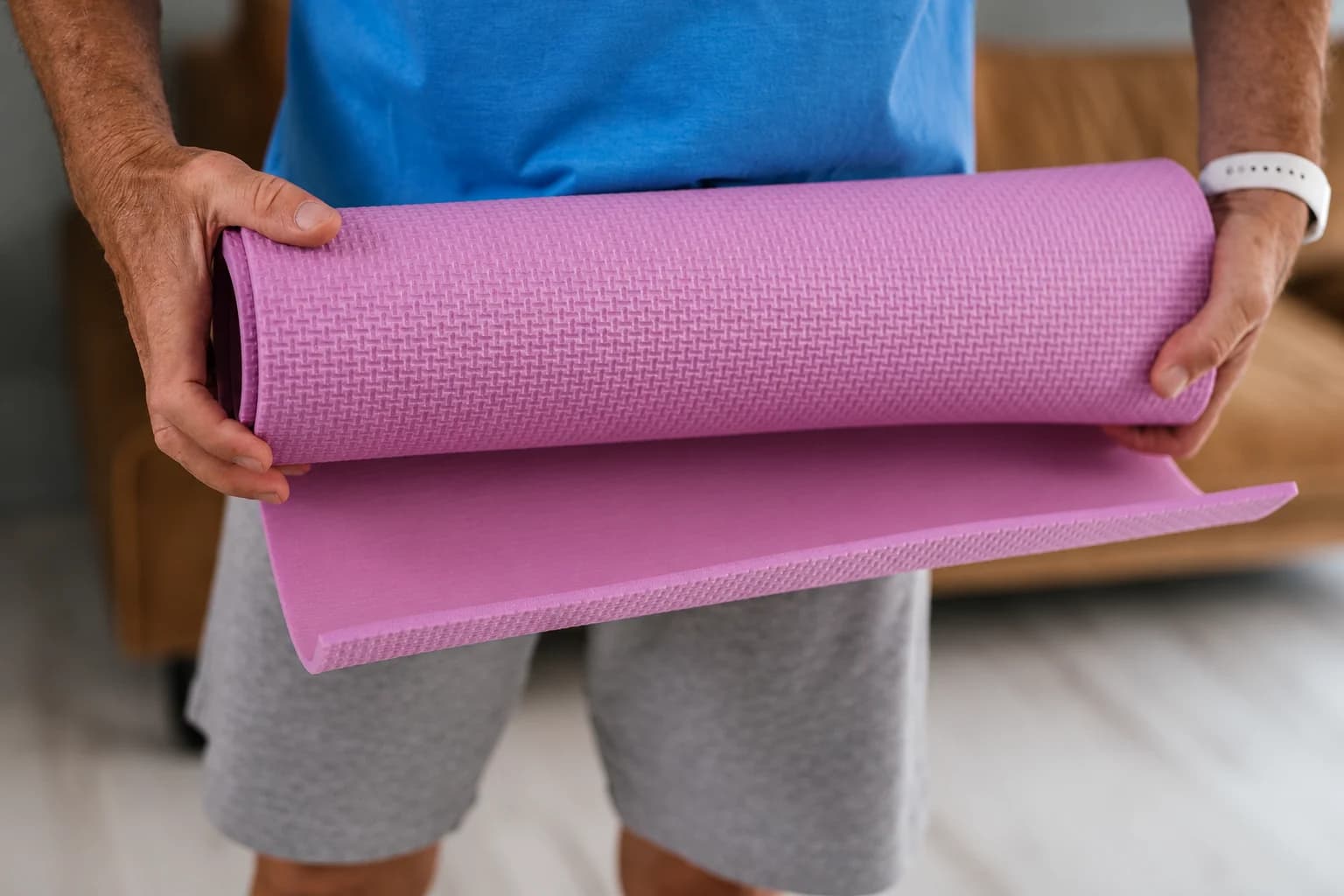
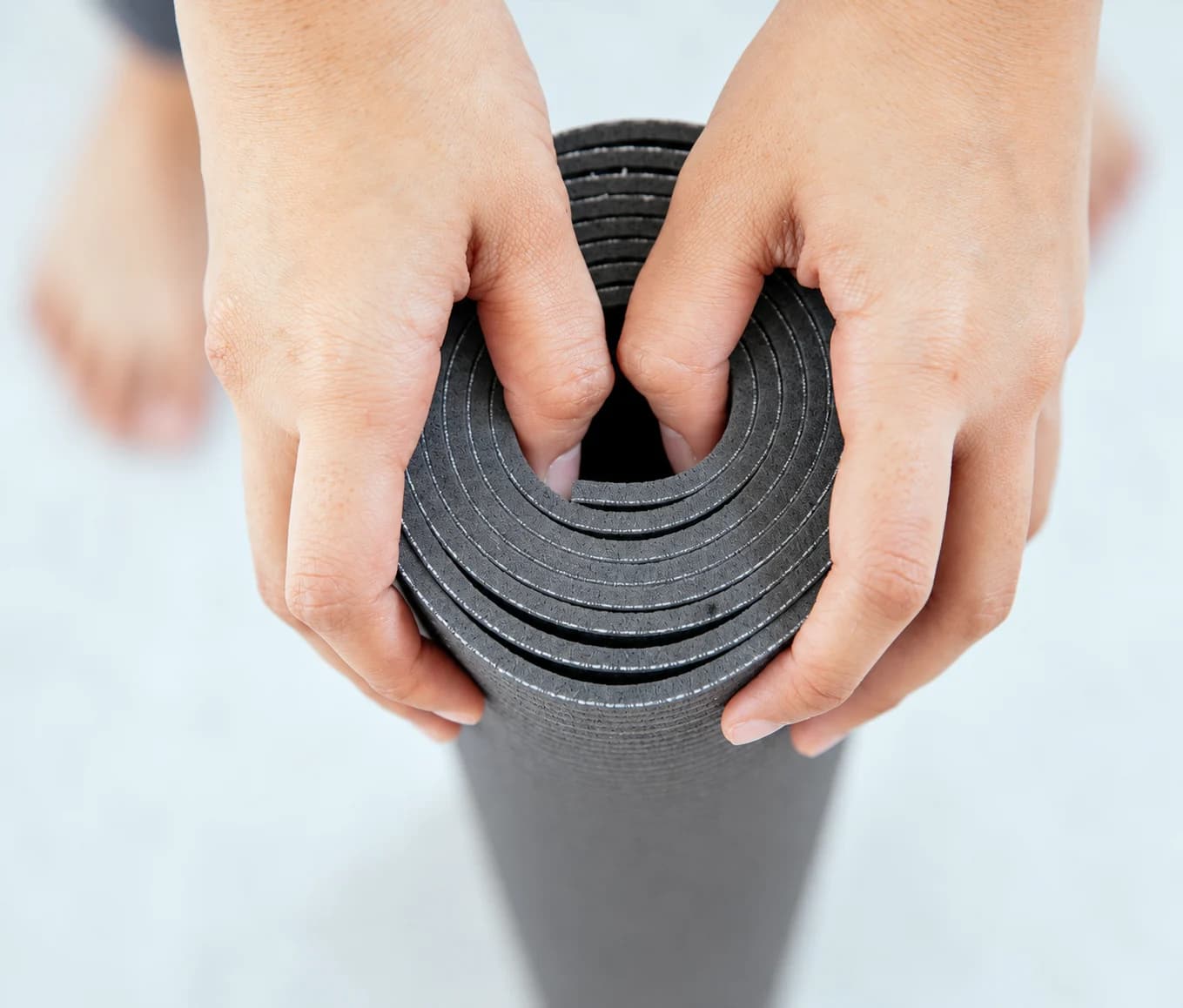
Compare its actual packed shape with your luggage needs before choosing. Confirm the permitted folding and care method for this model, and obtain or measure its folded dimensions with the storage bag included. The rolled mats in the photographs are different products and cannot establish how this one packs or feels.
Dry and store according to the model
Allow for care before you close the bag. Manduka's instructions for the named natural-rubber Superlite call for gentle cleaning and complete air-drying, flat or hung, before rolling. They warn against damp storage, soaking, harsh chemicals and heat or sun exposure. Those instructions do not establish the correct cleaner for a TPE mat.
Jade's Voyager guidance also has model-specific storage and sun restrictions. Follow the directions for the mat you own rather than borrowing another maker's cleaner or treating a drying instruction to lay flat as a promise that creases will disappear immediately.
Use this travel mat comparison before choosing
- The flat dimensions suit the familiar practice I plan to do.
- The actual packed mat, with its cover, fits my bag and opening.
- I know the difference between the mat's thickness, carried mass and shipping package.
- I can check its contacts on the destination surface and adapt the practice if necessary.
- I have a workable plan to clean, dry and store this exact model.
If compact packing is the priority, compare verified packed dimensions first. If practice feel is the priority, start with a surface you already find suitable, then decide how to carry it. A familiar rolled mat may already meet the trip's needs; a folding model is useful when its actual shape and practice surface fit yours.