Boxing Reflex Ball Guide: Choose, Set Up and Practise
Choose and set up a headband reflex ball, learn gentle first contacts and alternating hands, resolve common problems and track progress with clear limits.
Start a headband boxing reflex ball with a soft beginner ball, the kit's instructed cord setting and one light contact followed by a deliberate stop. Learn to see the return before connecting more taps. Choosing suitable equipment, checking the area and knowing how to reset are part of the task.
This guide follows that whole process: choosing a kit, fitting and adjusting it, first contacts, alternating hands, common problems and a simple progress record. The cover shows general boxing preparation; the headband-ball task itself is different from coached boxing technique, opponent reactions or sparring.
Go directly to the headband-ball task
| Question | Section |
|---|---|
| Fit and inspect the wearable kit | Setup |
| Learn one or two light contacts | First hits |
| Face contact, slip or tangles | Stop and check the return |
| Record consistent attempts | Progress record |
For the different externally attached target, read the double-end bag guide. Check its actual model documentation separately; the headband assembly here cannot set it up.
Choose a headband reflex ball by its instructions
Identify the complete system before comparing kits. A headband ball has a wearable band, an elastic tether and a ball. An untethered irregular reaction ball is bounced or dropped for catches. A double-end target connects to external attachments. Similar names do not make their setup, space or use interchangeable.
For a first headband kit, ask which ball the maker identifies for light beginner contacts and how its difficulty options differ. Colour is not a cross-brand standard for firmness, mass or return. The Protocol kit manual, for example, distinguishes its ball-and-string combinations by resistance; the number of balls alone does not explain the task.
| Buying check | Useful information | Clarify before choosing |
|---|---|---|
| Beginner option | Named soft first-use ball and matching instructions. | Difficulty shown only through colours. |
| Headband fit | Adjustment range, closure and attachment location. | Adjustable or one size with no usable fit details. |
| Cord setting | Defined adjustment point and secure spare-tail arrangement. | A loose elastic pictured without a fastening method. |
| Ownership | Compatible replacements, care and intended user information. | Unidentified parts or instructions for a different kit. |
Check whether a listing includes the full headband assembly or only spare balls. For shared use, each person needs an appropriate fit and a repeatable setting. If an app or counter is offered, verify compatibility, account requirements and whether the hardware works without it. A pouch makes storage convenient; it does not provide clear practice space.
How to set up a reflex ball
Lay out the band, ball, elastic and supplied fittings with everything relaxed. Inspect both cord ends, the band attachment, closure and any connector. Stop for cuts, thinning, loose stitching or exposed hard parts that could contact the face or hand. A component photo can identify the broad relationship; the exact manual must explain its assembly.
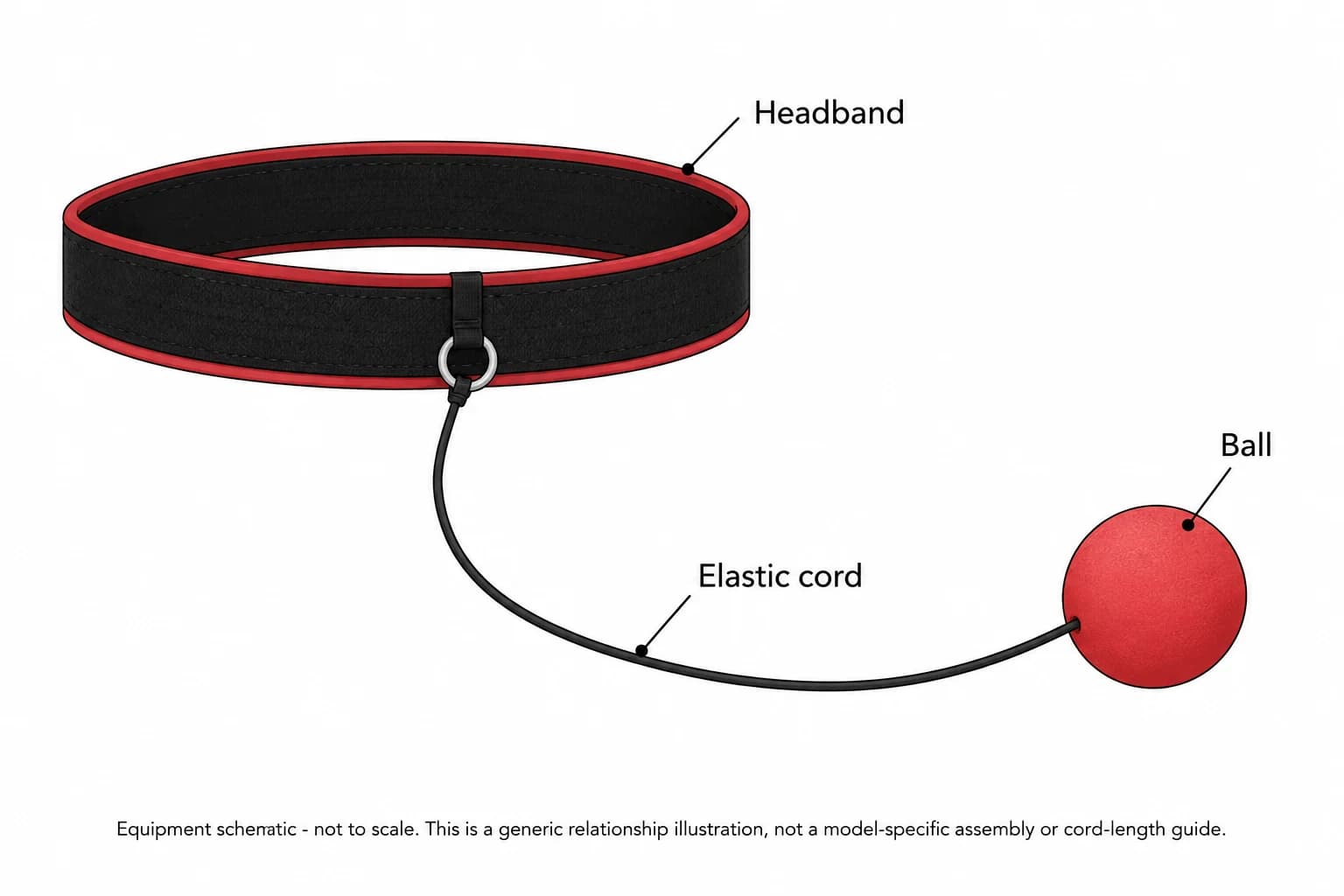
- Fit the band in the position shown for your kit. Keep it flat and engage the closure fully. Centre a front attachment only when that is the instructed arrangement.
- Check comfortable stability while the ball rests. A small head movement should not pull the band toward your eyes. Discomfort is a reason to reassess fit, not keep tightening.
- Find the manual's starting cord setting and its measurement endpoints. Check the relaxed assembly without pulling the ball down to make it reach a body reference.
- Remove the band before altering an adjuster, knot or cord. Secure the attachment using the supplied method, keeping unused elastic controlled as instructed.
- Refit the band in the clear area and try one very light contact. Stop and inspect again if an attachment moves or the return remains unmanageable.
How long should a reflex ball be, and how do you shorten it?
There is no universal cord length for every ball and elastic. The TekXYZ Classic manual uses a forehead-to-navel starting reference for that range. That is a manufacturer starting point, not a measurement to transfer to any headband ball or a reason to stretch the cord while measuring.
Check whether your instructions mean cord alone, attachment-to-attachment distance or total hanging assembly. Record those endpoints and keep the elastic relaxed unless the manual explicitly requires something else. Pulling a ball down while measuring can leave it much higher once released.
To shorten the working section, take the band off, rest the ball, release the intended adjustment point and make a small permitted change. Secure it exactly as directed and test again before another change. Ball choice, elastic and tap direction also affect the return, so shorter does not automatically mean better.
How to tie a reflex ball depends on its attachment. TekXYZ specifies a triple knot at its Classic stitched swivel and a separate plug arrangement at the ball; another kit may use a clip or adjuster. Do not treat that knot count as universal, add a knot in the working section or wind spare elastic around the neck, fingers or wrist. Ask for the correct method if the connection is unclear.
The Punch Equipment setup guidance advises testing the setting before cutting excess string. Keep the trial reversible until the instructed fit works. If trimming is required, remove the band and follow the specified remaining-tail guidance; do not cut away the length needed to secure the attachment.
Reflex ball space requirements include the missed return
Check three areas: where your hands travel, where the ball might travel and where you can stop after a miss. Look in front, beside and above you, as well as behind the elbows. Move screens, glass, lamps, loose floor items and trailing cables out of the area. Keep other people and pets separate from practice.
No single room dimension fits every kit and person. A tether does not keep every off-centre return in front of you, and the Protocol manual warns about the assembly coming loose. Do not test clearance by stretching the elastic to its limit or striking hard.
Begin only when footing, visibility and a stopping route are suitable. Outdoors, reassess uneven ground, passers-by, branches, glare and permitted weather conditions. A setting that works for settled feet and small taps does not automatically accommodate steps, turns or tricks. If you must hold an awkward position to avoid furniture, choose another location or activity.
Boxing reflex ball for beginners: one contact, then two
Use the first-use ball identified by your actual kit. The TekXYZ Classic progression begins with its novice option and light taps; do not choose another brand's ball by matching a colour. Follow the kit's guidance on age suitability and any hand or eye protection. If you need glasses to see clearly, choose an activity compatible with that need rather than practise with blurred vision.
- Hold the ball still without stretching the elastic and release it into the instructed starting position. Keep a balanced stance and relaxed shoulders.
- See the ball, make one small contact in the direction your kit teaches and stop. Let the motion settle before collecting and resetting it; do not sweep after a miss.
- When the return is recognizable, try a second light contact and finish deliberately. Repeat that pair before extending it, without adding force simply to keep the ball moving.
TekXYZ's beginner guide uses a downward tapping cue for its equipment. It is a starting cue for this ball task, not a full-power boxing punch. Avoid driving the target straight toward your own face. If a contact hurts or the return is frightening, stop and reduce the demand or end practice.
Keep the same ball and cord setting while learning a short sequence. Count deliberate contacts rather than accidental touches against clothing. Reset after a miss, band movement or cord wrap. You do not need a timed round or a minimum streak for the attempt to be useful.
For a visual reference, the TekXYZ Classic video manual page offers setup and string-replacement video controls. Follow the matching kit and version; a video of another system does not establish your fastening or length.
Reflex ball alternating hands: connect a pair calmly
First establish a manageable return using the more comfortable hand. Then try one left contact followed by one right contact and stop. Repeat with the right hand starting. The two roles may feel different, so keep the starting side in your notes. These are adjustable practice examples, not readiness tests.
Prepare the next hand while watching the return. A left-right rule does not require forcing the ball to follow a metronome. Wait for an appropriate contact rather than insert a same-hand rescue hit. If the ball drifts across the body or both hands chase it, let it settle and restart.
Later, connect two pairs while keeping the same basic tap and equipment. Add another pair only while the sequence remains controlled. Changing the ball, shortening the cord and extending the count together hides what changed. The hand-order exercise is separate from learning a boxing guard or combination.
Reflex ball hitting your face: stop the sequence
Repeated face contact is a reason to reduce the task or stop, not a training requirement. Let the ball settle, remove the band and check the beginner ball, relaxed cord setting and attachments. Reduce tap force before shortening the cord again. A fast horizontal strike can create a very different return from a gentle learning contact.
Restart with one small contact only if the setup and return are manageable. Do not lunge or make dramatic dodges to save the streak; the tether moves with your head. Stop for pain, eye irritation or difficulty seeing. Eye symptoms or a significant impact need appropriate advice, rather than treating another drill as an injury assessment.
Reflex ball headband slipping: check when it moves
A band that moves during a small head movement has a different problem from one that shifts only after a hard hit. With the ball resting, check placement, closure engagement, folds, hair trapped beneath it and the stated fit range. Do not stretch an unsuitable band beyond its range to gain overlap.
If it shifts only under harder contact, return to the beginner setup and smaller taps before tightening. Pause when moisture changes the fit and follow cleaning and drying instructions. Do not add pins, staples, adhesives or rough material near the skin. Comfortable stability and clear vision are restart requirements; enduring pressure is not a skill goal.
Reflex ball string tangling: relax it before clearing
Stop hitting, let the ball settle and take the headband off. Lay the assembly down without stretching the elastic. Open the visible outer crossings gently, keeping the intended attachment fastening intact. If a loop surrounds a finger or wrist, reduce tension before freeing it rather than pulling the ball away against the elastic.
Distinguish an accidental knot from the kit's intended fastening. Check whether unused tail has entered the hand path, whether a sweeping rescue contact crossed the cord or whether a twist recurs near an attachment. Do not steer the ball with a finger hooked around the elastic or cut a tangle beside skin.
Restart with one smaller contact only after the working path is clear. A permanent kink, thinning or repeated snag at rough hardware calls for a condition check. Shortening every tangle changes the task without identifying its cause.
Reflex ball replacement string: match the whole system
Inspect from the band attachment to the ball entry, including visible areas beside knots, swivels or inserts. Do it with the band removed and the cord relaxed. Do not use maximum stretching, hard hits or snapping the elastic back as a condition test. Stop for cuts, fraying, separating stitches, a failing closure or a connector that no longer seats as instructed.
Identify the exact model before ordering a cord, pre-attached ball-and-cord unit or complete replacement. Similar colour or diameter does not establish compatible elastic behavior. TekXYZ's Classic manual describes its own plug-and-knot replacement arrangement; it is not permission to force open an unfamiliar sealed ball.
After a permitted replacement, inspect the connections, restore the recommended start and return to single light contacts. Clean and dry each component as directed, and store the assembly relaxed and untangled, clear of sharp objects. A replacement-date note can help identify the part later; there is no universal replacement calendar here.
How to make a reflex ball: understand the DIY tradeoff
A parts list is easy to describe: a band holds an attachment, elastic provides the tether, a ball supplies the contact surface and connections retain the assembly. Making those parts work together predictably is the harder question. A soft ball alone cannot establish that its cord entry holds; a comfortable band cannot establish a homemade anchor's suitability.
A documented kit should identify its beginner option, adjustment, inspection and replacement method. DIY adds decisions about ball suitability, elastic, both attachments and future care. A neat-looking knot or universal replacement label cannot resolve them. Compare the complete project and its uncertainty with an instructed full kit, rather than comparing a kit price with the cost of a loose ball.
Do not imitate a kit with a hard ball, exposed metal, sharp hardware or an improvised rigid connection near the face. Replacing an approved part by its matching manual is a different task from inventing a new assembly. If compatibility and a dependable connection remain unclear, choose a documented system instead of experimenting through use.
Do boxing reflex balls work? Keep the outcome specific
The activity asks you to locate a small target, time a contact and adjust to its tethered return. You also created the previous contact, which makes the information different from an opponent choosing distance, direction and timing. A steadier streak can show more consistent performance at that particular ball task; it does not by itself measure faster reactions in milliseconds or better boxing defence.
A systematic review of anticipation in combat sports compared expert and non-expert performance across tasks. The sporting context matters when interpreting those results. It was not a training trial showing that headband-ball practice improves boxing, and an expert using an accessory does not isolate the accessory's effect. Use appropriate coaching and representative practice for boxing skills.
Is a reflex ball a good workout? It may be an enjoyable active coordination task, but movement, rest and resets vary. A contact score cannot establish energy expenditure or a complete fitness routine. The Boxbollen brand report using watch estimates describes its reported sessions, not a fixed calorie rate for every kit. There is no need to chase a harder return to make a session count.
Choose it if you enjoy a manageable hand-and-ball challenge and can use it comfortably. If the fit remains poor, returns are uncomfortable or you dislike the task, another activity may suit you better. Enjoyment and repeatable control are sufficient reasons to practise without a promised sporting transformation.
Reflex ball progress: keep the denominator and the rules
Choose a task before counting. Record the kit, maker-identified ball, relaxed cord setting and starting hand. Define a clean completion and what ends an attempt. Keep equipment or space stops separate from ordinary misses so the score never rewards continuing through a problem.
| Log field | Example entry |
|---|---|
| Task | Two alternating pairs, then an intentional stop. |
| Equipment and setting | Same kit, beginner ball and named relaxed cord setting. |
| Attempts and completions | Six attempts; four followed the rule. |
| Typical reset | Repeated left-hand contact after the first pair. |
| Control note | Could wait for most returns without reaching. |
| Next session | Keep the setup and count; try starting right. |
Four completions out of six attempts is clearer than four successes alone. Compare several like-for-like entries. Fewer rescue movements at the same count can be useful progress; a new ball or setting begins a different comparison. Make one small next change, such as the starting hand or another pair, while keeping the option to simplify.
A double-end boxing ball is a different setup
The PBGGAME double-end elastic rebound boxing ball is a separate equipment category with opposed external attachments. It is not a headband kit, and the wearable setup, knot and first-contact instructions above are not its manual. Read the double-end bag guide before considering this different format, then obtain the exact model’s mounting requirements and permitted use. No anchor or installation method is supplied here.