Resistance Band Training for Golf: Support Strength Around Swing Practice
Explore source-backed band exercise examples for golf conditioning, match the equipment format and keep strength support distinct from swing instruction or distance promises.

Golf exercises with resistance bands can give supplementary strength work a clear purpose alongside swing practice. Start with the physical task you want to train and an exercise you understand, then check which band format the exercise requires. Trying to make a resisted movement look like a golf swing does not, by itself, establish a useful transfer to your game.
A named exercise needs a purpose
In his TPI guide to needs analysis and programme design for golfers, strength and conditioning coach Mike Carroll includes the band pull-apart among examples addressing thoracic position, control and mid-back strength. Carroll has a sport and exercise science degree and UKSCA accreditation; the exercise belongs to his discussion of a golfer's individual needs.
Use that example to ask a specific question about your own supplementary work. Is the aim relevant to what you and your coach have identified? Carroll's other examples form his own progression, rather than a sequence every reader should copy. The original article provides the context for the named exercise without turning a band drill into a lesson in swing technique.
Two shoulder-band exercises to find in the original guidance
The NISMAT golf-exercise page includes named band exercises and links to demonstrations. These two entries give you specific options to discuss with the professional helping your conditioning:
| Exercise name on the NISMAT page | What the entry addresses |
|---|---|
| Shoulder External Rotation with Theraband | A resisted shoulder external-rotation exercise. |
| Shoulder Internal Rotation with Theraband | A resisted shoulder internal-rotation exercise. |
The page links to hospital demonstrations of external rotation and internal rotation. Use the original guidance rather than treating a movement name as complete instruction. The examples use an anchor arrangement, which needs to match the exercise guidance and the instructions for the actual equipment. Do not improvise a fixing from the name of the drill.
The source uses Theraband in its exercise names. Use those conditioning examples to understand the named movements, then follow the resistance, setup and use instructions for your selected PBGGAME band. Obtain personalised professional guidance for rehabilitation needs.
Locate the exercise before copying a band setup
| Source entry | Where to look | What it does not establish |
|---|---|---|
| NISMAT external rotation | The named Shoulder External Rotation with Theraband entry and its linked demonstration | A timestamp or permitted PBGGAME anchor arrangement |
| NISMAT internal rotation | The named Shoulder Internal Rotation with Theraband entry and its linked demonstration | Equivalent resistance from another band format |
| Johansen review | The abstract and study-design details linked below | A promised distance gain from one band set |
What golf resistance training research can establish
A 2026 systematic review and meta-analysis by Johansen and colleagues examined physical training and golf-shot performance. Its published abstract reports thirty-three studies involving 798 golfers. The interventions included different forms of physical training, rather than only resistance-band exercises.
The review rated the controlled evidence as low certainty and the single-group evidence as very low certainty. Its findings support considering physical conditioning, while leaving uncertainty about the effects of particular approaches. They do not establish a distance gain for these band products or promise that an individual golfer will improve by a stated amount.
Twenty-six studies included a comparison group; seven followed a single group. That distinction matters when interpreting change over time. Improving during a training period is a different observation from showing a better result than an appropriate comparison group. Read the study design alongside the headline.
Keep the training method, measured outcome and evidence quality together when reading a performance claim. A result for a mixed physical-training intervention should not become a guarantee attached to one accessory.
Choose bands for golf conditioning by format
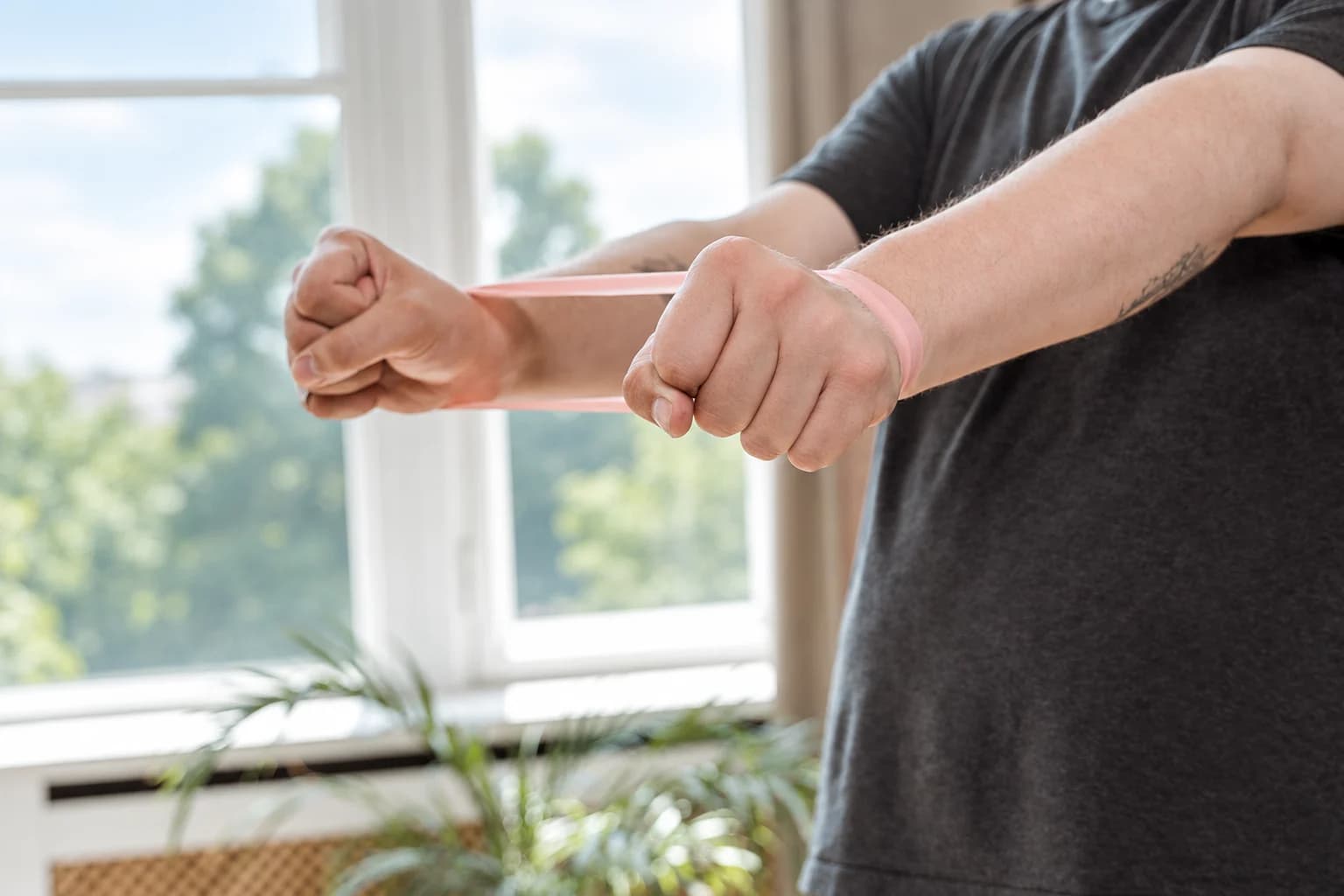
Before choosing equipment, look at how the named exercise uses its band. Does the original guidance show a strip, a closed loop or another format? Is the band held directly, used with a handle or attached to an anchor? Those details matter more than a product being described generally as suitable for golf.
The PBGGAME long-loop band kit with detachable foam grips is one format to compare with equipment guidance for an exercise you have already selected. The A option contains five long flat closed loops, five short loops, two foam grips and carabiners, plus an anchor, bag and guide. It was listed at $18.99 when this article was prepared.
The loops are flat and closed, rather than tubes or an open strip of Theraband. Detachable grips provide a different way of holding compatible parts of the kit; their presence does not turn every published band exercise into a suitable use. Check the exact configuration with the equipment instructions and the professional helping you choose the movement.
Colour and printed resistance labels are another reason to check the particular item. A label on this set does not give you a calibrated force for your body position or an equivalent setting on a different manufacturer's band. Choose the exercise and appropriate equipment together, without converting a printed number into a golf-training prescription.