Resistance Band Force Curves: Why the Pull Changes Through a Repetition
Read band tension in relation to extension and reference length. Separate an external force curve from changing joint geometry and compare the equipment actually tested.

Stretching the same band farther generally increases its pull. A resistance band force curve describes how resistance band tension changed under particular test conditions. The amount of change depends on the band and setup, and a force curve does not map the entire muscular task.
Two conceptual diagrams in numbers
| Length reference — arithmetic only | Length | Change from reference |
|---|---|---|
| Unstretched reference L0 | 100 arbitrary length units | 0% extension |
| Movement starts after pre-stretch | 150 of the same units | (150 − 100) ÷ 100 = 50% |
| Another position in the example | 175 of the same units | (175 − 100) ÷ 100 = 75% |
| Same force, different perpendicular distance — physics example | External force | Perpendicular distance | Turning effect F × distance |
|---|---|---|---|
| Geometry A | 10 N | 0.10 m | 1 N·m |
| Geometry B | 10 N | 0.20 m | 2 N·m |
These invented numbers illustrate labels and arithmetic, not a force curve, tested PBGGAME values or a permitted stretch. A length/extension axis needs its reference; a force axis needs a measurement. The OpenStax force-and-torque explanation supplies the geometry distinction. The longest band position alone does not locate the greatest joint turning demand.
Read the measurement behind a force claim
In a technical note by Uchida and colleagues, two trained observers used a tensiometer to measure eight colours of a particular brand's elastic bands at ten elongations. The measured values differed from the manufacturer's references for multiple colours.
The result makes the tested band and its extension important context. It does not provide a force curve for a PBGGAME product or a universal conversion between brands. When a chart accompanies a product claim, look for the identity of the tested item and the conditions behind the measurements before transferring the result to your own equipment.
Elastic resistance: separate reference length from starting length
The AGUEDA technical report by Fernandez-Gamez and colleagues profiled seven specific bands under controlled stretching. Extension was expressed relative to unstretched reference length.
| Description | What it tells you |
|---|---|
| Unstretched reference length | The baseline used to describe the change in band length. |
| Length at the start of a movement | The band's condition when that particular movement begins. It may already be stretched. |
| Extension relative to the reference | How the change in length compares with that baseline. |
Starting a repetition and starting from an unstretched band are therefore different descriptions. The same visible movement also need not produce the same relative extension in bands with different reference lengths.
The fitted lines describe that tested range, not every band's curve or a safe extension limit.
Band loading through range includes the line of pull
OpenStax's physics explanation of muscles and joints distinguishes force from its turning effect around a joint. The line of action and its perpendicular distance from the joint matter to that turning effect.
For an exercise, a chart of external band force and a description of joint loading answer different questions. A larger measured pull does not by itself establish where the joint experiences its greatest turning demand. The geometry can change as the body and equipment move.
That is why “the band is longest here” is incomplete evidence for “this is always the hardest joint position.” Keep the pull and its arrangement in the explanation, rather than treating a force curve as a complete map of the muscular task.
Two equipment formats to keep distinct
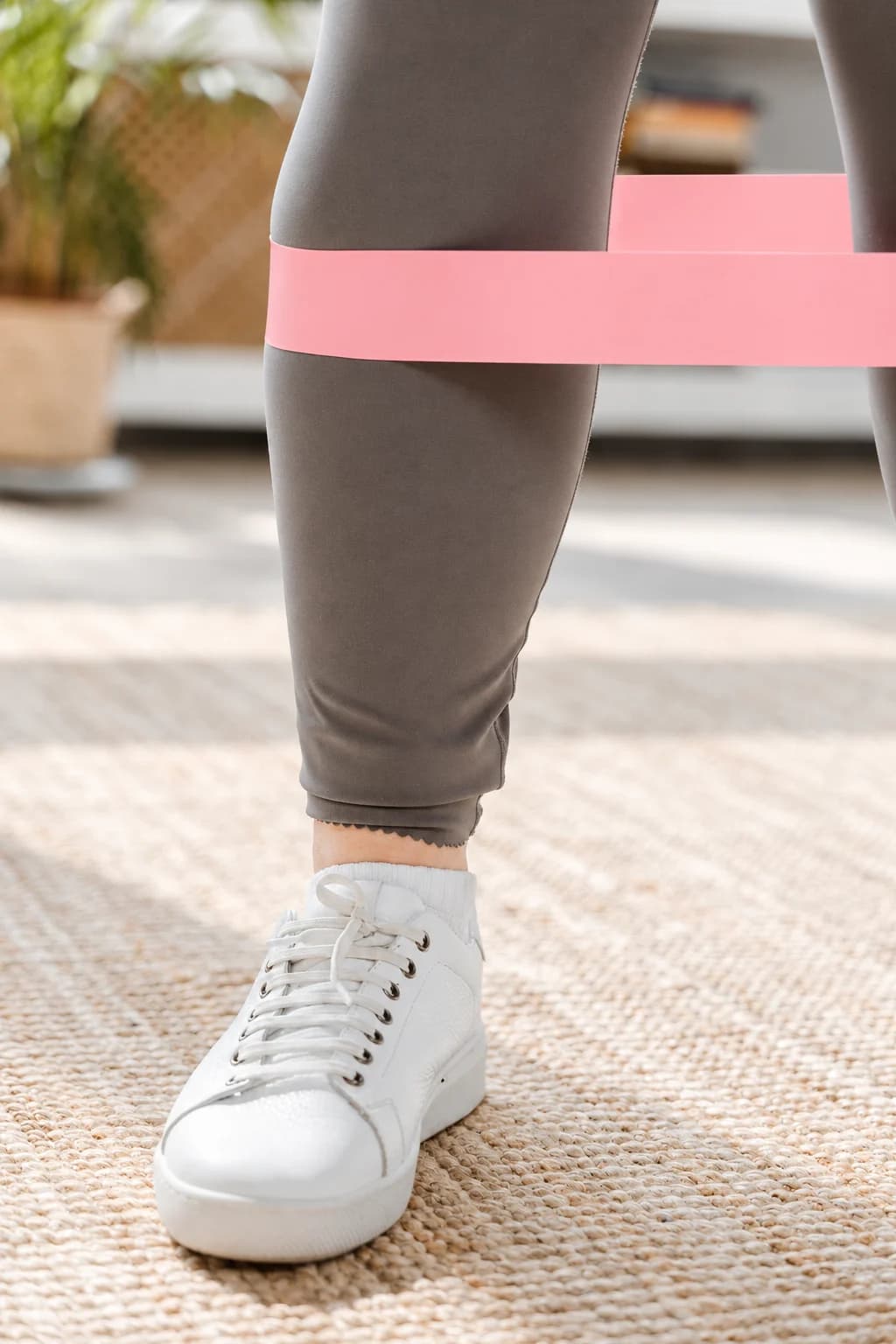
The PBGGAME flat long-loop band set provides five flat closed loops and an anchor. The selected five-piece option was listed at $23.99 when this article was prepared. Its loop format is a useful physical detail to retain when comparing it with a study or a manufacturer's measurement report.
The PBGGAME clip-on resistance-tube set uses five round-section tubes with end clips. The set also includes two foam handles, two ankle cuffs, an anchor, a bag and a guide. It was listed at $18.79. These are different physical components from the flat closed loops above.
Keep those identities attached to any claim about force. A curve for a particular flat strip is not automatically a curve for either of these sets, and an accessory does not supply the missing measurement. Use the exact equipment instructions to determine the intended configurations; a clip or anchor in the package does not establish compatibility with every improvised setup.
The useful product comparison here is the format and contents you would receive. A ranking of which set supplies more force at a given point would require appropriate measurements of those particular items and conditions.
A short sequence for reading a force curve
- Identify the tested product and the measurement setup. Keep a report about one sample separate from a claim about another item.
- Read the horizontal axis. Establish whether it describes length, relative extension or another variable, and find the reference used.
- Read the output. External force and a joint's turning demand are different quantities; keep the exercise geometry in the interpretation.
If the labels around the exercise are the confusing part, our guide to elastic, isometric and isotonic terminology explains that separate distinction. Here, the central question is what a measurement says about the particular band as it extends.