How Often Should You Stretch? Build a Repeatable Practice
Put general stretching-frequency advice in context, understand what the research can establish and build a repeatable plan with a small weekly record.

How often should you stretch? For a regular flexibility practice, Mayo Clinic suggests at least two to three times a week. That offers a starting point for planning, rather than a requirement to stretch every day or a promise about how quickly your range of motion will change.
The useful next question is which opportunities you can repeat. A calendar filled with sessions you rarely complete gives you less information than a realistic plan and an honest record of what happened. Consider your goal, existing activities and any individual guidance before deciding where stretching belongs in your week.
Two scheduling examples to copy
| Calendar example | Planned familiar practice | Actually completed | Obstacle / next planning question |
|---|---|---|---|
| Two opportunities: Monday and Thursday | Name the existing routine: ____ | Monday: ____; Thursday: ____ | ____ |
| Three opportunities: Tuesday, Friday and Sunday | Name the existing routine: ____ | Tuesday: ____; Friday: ____; Sunday: ____ | ____ |
| Your own repeatable opportunities | Days / context: ____; routine: ____ | ____ | ____ |
These rows demonstrate calendar recording only. They do not prescribe movements, hold times or a superior frequency. In the Ingram review’s abstract, the 189 studies / 6,654 adults and non-significant frequency moderator refer to the analyzed studies; they do not prove that every two-day and three-day plan is equivalent.
What the general frequency advice means
In its guide to stretching and flexibility, Mayo Clinic says even five to ten minutes at a time can be helpful when stretching is regular. That is general health information, rather than a complete routine for every person or a requirement to fill that time every day.
The same guide cautions against treating stretching as a warm-up. It also advises people with chronic conditions or injuries to discuss possible technique adjustments with a doctor or physical therapist. Keep those individual needs attached to the advice when planning your practice.
Stretching frequency is one part of the research question
A systematic review and meta-analysis by Ingram and colleagues examined static stretching and flexibility in adults. The published abstract reports 189 studies involving 6,654 participants, including short-term and longer-term interventions.
For longer-term flexibility changes, weekly stretching frequency was not a statistically significant moderator in the authors' analysis. That does not establish that all schedules are equivalent or that frequency never matters. It also does not justify assuming that adding more days will automatically produce a larger improvement.
The research question concerns measured range-of-motion outcomes across studies. Your planning question includes whether the arrangement fits your week and whether you actually follow it. A study finding cannot fill in your personal schedule, choose movements for an injury or promise a result by a particular date.
Give the practice a clear job
Before choosing days, finish this sentence: “I want a regular stretching practice because…” Your answer might concern an existing activity, a flexibility goal you have discussed with an instructor, or keeping time for an already-familiar routine. A clear reason makes the calendar decision more useful than collecting another generic sequence of movements.
Then identify what you are already doing. A class, a guided session and a separate practice at home should all be visible in your planning notes. Otherwise, you may keep adding calendar entries without understanding the week you already have. Record what each activity actually includes rather than assuming every class labelled “mobility” has the same content.
You also need a consistent meaning for “completed.” If the entry names a familiar routine, record whether you did that routine and any changes. If it only says “stretch,” it will be harder to understand later. This is about making your notes interpretable, rather than earning a streak or judging every shortened session as a failure.
A short daily stretching practice is an option to evaluate
A short daily stretching practice may be the schedule you are considering. Separate that preference from the claim that daily stretching is necessary for everyone. The general recommendation above leaves room for other regular arrangements, and a calendar preference does not establish a superior flexibility outcome.
Think about what makes the chosen time available. “After an appointment that often runs late” and “during a reliable gap at home” describe different opportunities, even when both appear as a free box in a calendar. Choose an arrangement that reflects your actual week, then look at what happened before adding more entries.
If an opportunity repeatedly disappears, note the reason. Lack of space, forgotten equipment and an unrealistic calendar slot call for different planning changes. A missed entry by itself cannot tell you that the movements were unsuitable or that your flexibility has changed.
Keep a small weekly record
Use the same few fields each week so that a plan and a completed practice remain distinguishable. There is no need to turn the record into a score or copy another person's schedule.
| Field | What to record |
|---|---|
| Planned opportunity | The day or existing calendar gap you intended to use. |
| What happened | The familiar practice you actually completed, including any changes. |
| Practical obstacle | Something observable, such as a late appointment or unavailable space. |
| Question for the next review | What you want to clarify about the schedule or existing guidance. |
This table records consistency; it does not measure flexibility. If you want to compare a movement over time, our mobility-progress guide explains why the setup and the observation need to stay clear. Keep that outcome record separate from the simple question of whether you made time for practice.
Make the practice easy to return to
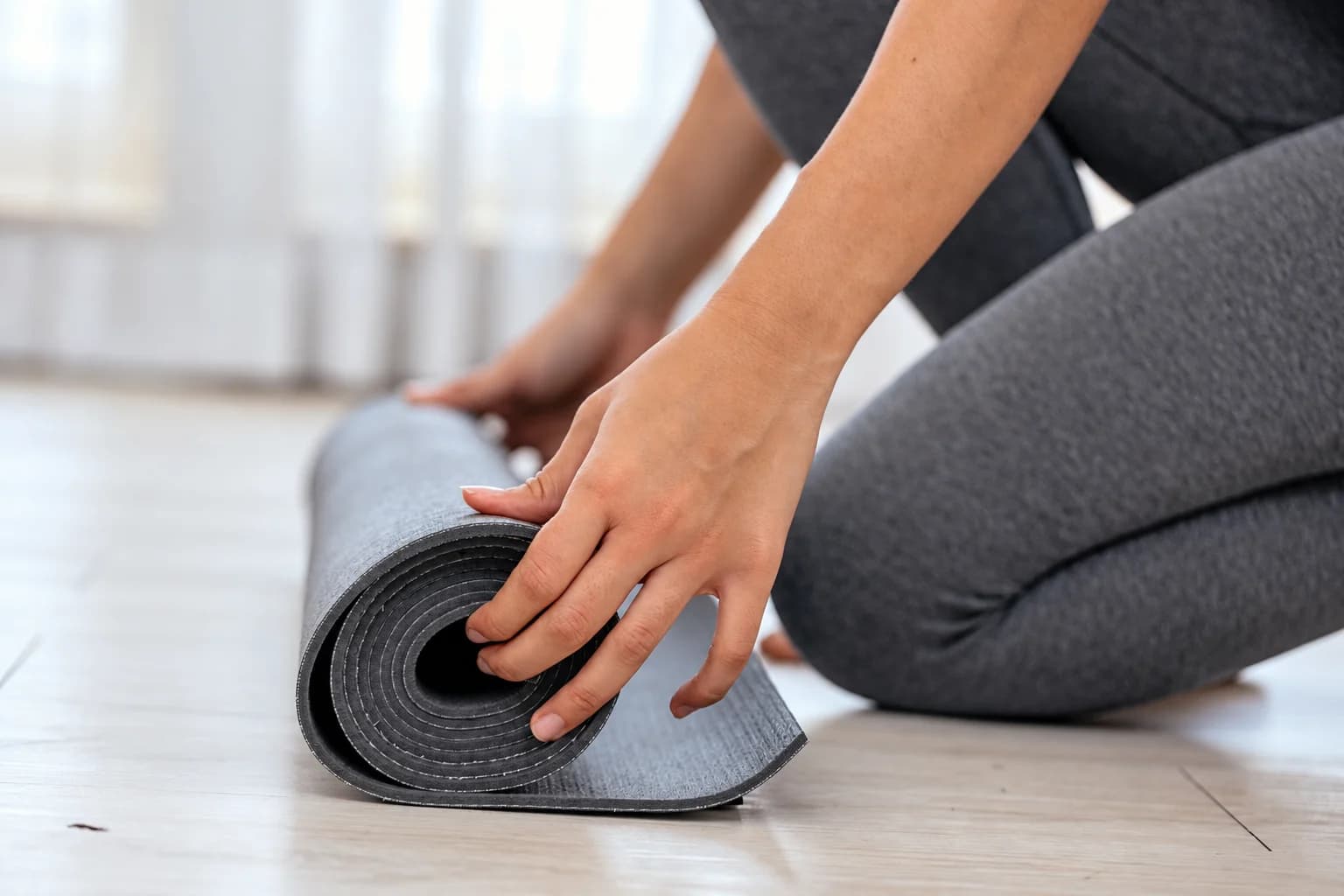
For an established floor-based practice, look at the small setup tasks that occur each time. Is the intended area available? Can you put the items away somewhere you can find them again? Having a place for the routine can make the plan easier to organise without adding another exercise or extending its duration.
If that existing practice uses a separate contact pad, the PBGGAME textured NBR foam yoga knee pad is one option. The selected Black — Pack of 1 variant is a single rectangular foam pad with a ribbed surface, listed at $23.99 when this article was prepared. It is a small pad rather than a wearable sleeve, a pair of pads or a full exercise mat.
Consider it for that specific setup role. Buying a pad does not determine your stretching frequency or establish a flexibility benefit. Check the live listing and follow the instructions for the exact item if it belongs in your existing practice. The decision about your schedule still begins with your goal, the guidance relevant to you and the opportunities you can repeat.